Artificial intelligence has arrived in African workplaces, classrooms, and newsrooms faster than most people anticipated. From Nairobi to Lagos, professionals are using AI tools to draft emails, write reports, summarize long documents, and generate content at a pace that would have been impossible just a few years ago. The productivity gains are real, and industries are feeling them.
But this shift raises a question that is becoming harder to ignore: when so much written content is assisted or generated by AI, how do we know what is genuine?
This question matters more in some contexts than others. For a business submitting a tender, for a student completing an assignment, for a journalist verifying a source, or for an employer reviewing job applications — the authenticity of written communication has real consequences. And the tools to address this question have become both more sophisticated and more accessible.
The Scale of What Has Changed
The numbers show how quickly things have changed. Research published in 2025 found that 74.2% of all newly created web pages now contain some form of AI-generated content. In academic institutions globally, AI detection has become standard in how submitted work is assessed—systems like GPTZero and Turnitin are now widely used in universities across Sub-Saharan Africa.
For working professionals, the implications are practical. A report drafted partly by an AI tool but presented as entirely original work creates a credibility risk that many people don’t fully appreciate until they face the consequences. The same applies to content produced for clients, for publication, or for any context where the expectation is original human thinking.
What AI Detection Actually Does
An AI content detector works by analyzing the statistical patterns in a piece of text — not individual words or phrases, but the aggregate distribution of how words are combined. AI-generated text tends to be highly predictable at this level: sentences follow similar rhythms, transitions are formulaic, and the overall pattern lacks the natural variation that comes from genuine human thought.
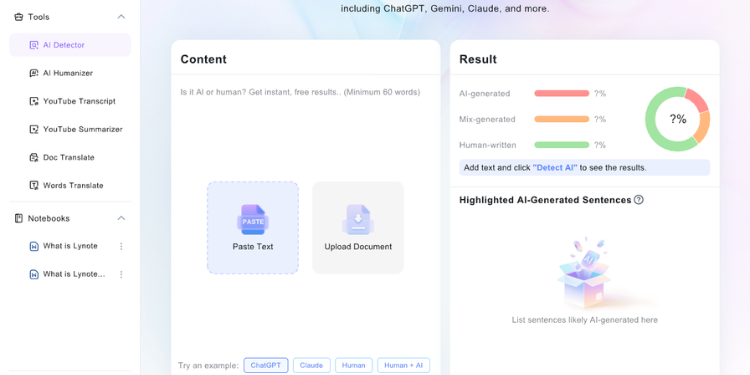
The Lynote.ai detection platform analyzes text against the output patterns of all major AI models — including ChatGPT, Claude, and Gemini — and cross-references results with academic detection systems including GPTZero, Turnitin, and Copyleaks. The result is a section-by-section breakdown that tells users not just whether content was likely AI-generated, but where in the text those patterns are most concentrated.
For professionals in Kenya and across Africa who are navigating the responsible use of AI tools, this kind of diagnostic is valuable. It is not about avoiding AI — these tools are legitimate and useful. It is about understanding the difference between AI assistance that supports your work and AI output that replaces the judgment and expertise you are supposed to be providing.
The Humanization Layer
Detection addresses the problem of identifying AI-generated content. Humanization addresses the problem of improving it.
Raw AI text often sounds flat—correct in structure but lacking the voice, specificity, and perspective that make writing genuinely useful. Lynote’s AI humanizer works at the structural level, varying sentence rhythm, adjusting formality, and eliminating the predictable patterns that make AI text recognizable. The result is content that reads as though it came from a person who actually thought about what they were writing.
This is especially relevant for professionals producing content in English as a second language. AI tools can help with drafting, but the humanization step ensures the output carries the natural language quality readers—and detection systems—expect from genuine human writing.
Looking Ahead
As AI adoption continues to grow across African economies, the questions around content authenticity are only going to become more pressing. Regulatory frameworks are developing globally, with requirements around AI content disclosure becoming more common. Platforms, employers, and academic institutions are all developing clearer expectations.
The professionals who will navigate this transition most effectively understand both how to use AI tools and how to verify and improve what those tools produce. Lynote.ai offers that combination — detection, humanization, and verification — in a single platform that is free to use at the basic level.
The tools to work responsibly with AI content exist. The question is whether we are using them.