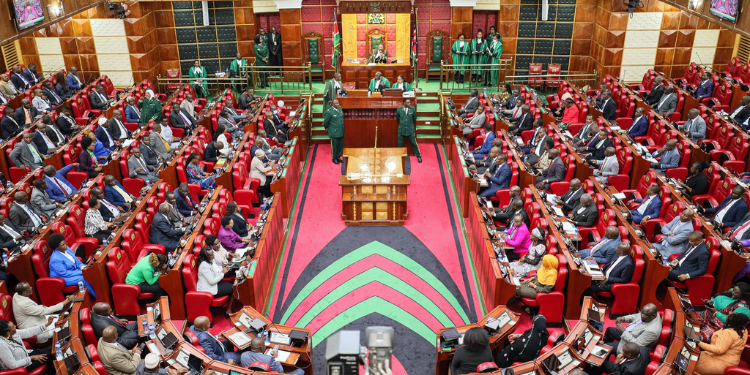
The National Assembly is set to debate The Law of Contract (Amendment) Bill, 2025, a proposal aimed at shielding consumers and businesses from unfair and unconscionable contract terms.
Sponsored by Wajir East Member of Parliament (MP) Aden Daud Mohamed and published in the Kenya Gazette on November 5, the bill seeks to overhaul the existing Law of Contract Act, which has long relied on English common law principles, leaving parties vulnerable to exploitative clauses.
The Bill introduces sweeping changes that prohibit the exclusion of liability in critical areas, such as negligence, breach of contract, and the sale of defective goods.
Key Provisions of the Contract (Amendment) Bill
One of the most significant reforms is the ban on clauses that exempt liability for death caused by negligence.
Under the proposed Section 3A, no party can contractually absolve itself from responsibility for fatalities arising from negligent acts.
“A person shall not, by reference to a contract term, exclude or restrict liability for death resulting from negligence.”
Similarly, liability for loss or damage due to negligence can only be limited if the term meets the test of reasonableness.
The Bill further targets consumer protection, with Section 3B preventing suppliers from excluding liability for losses arising from breaches of contract when dealing with consumers.
It also prevents businesses from delivering performance substantially different from what was promised or failing to perform altogether, which have been noted as the common loopholes exploited in service agreements.
Section 3C of the bill proposed by the Member of Parliament addresses defective goods, a persistent issue in the Kenyan retail and manufacturing sector.
The Bill proposes that guarantees cannot be used to escape liability when goods prove defective during consumer use, especially if negligence in manufacturing or distribution caused the defect.
Sale of Goods and Hire Purchase
Under the proposed Bill, a person cannot exclude or limit their liability for breaching fundamental conditions or warranties specified under Section 14 of the Sale of Goods Act or Section 8(1) of the Hire-Purchase Act.
For non-consumer transactions, exclusions are permissible only if they satisfy the reasonableness requirement.
Also Read: Mass Layoffs as Roofings Kenya Announces Total Shutdown of Operations
Furthermore, key consumer protections under the Sale of Goods Act (Sections 15, 16, 17) and the Hire-Purchase Act (Section 8(2)) cannot be excluded as against a consumer.
“Where the property in goods passes under or in pursuance of a contract not governed by the law of sale of goods or hire purchase , subsections (2), (3) and (4) apply as regards the effect to be given to contract terms excluding or restricting liability for breach of obligation arising by implication of law from the nature of the contract.”
English Common Law in Kenya
English common law was introduced to Kenya during British colonial rule through the East Africa Order-in-Council of 1897, which mandated the application of English law, equity, and statutes of general application.
This system formed the backbone of Kenya’s legal framework, particularly in civil and commercial matters, while customary law governed local communities.
Also Read: KeNHA Announces Permanent and Pensionable Jobs, Including Positions with KCSE Grade D Qualifications
After independence in 1963, Kenya retained this structure, and the Law of Contract Act (Cap. 23) explicitly extended English contract principles to the country.
Kenyan courts continued to rely on English precedents and applied English common law doctrines.
Over time, Kenya’s legal system has evolved and has been blending common law with statutory reforms and constitutional principles, especially after the 2010 Constitution, which emphasizes human rights, judicial independence, and the harmonization of inherited legal doctrines with local laws.
Follow our WhatsApp Channel and X Account for real-time news updates.