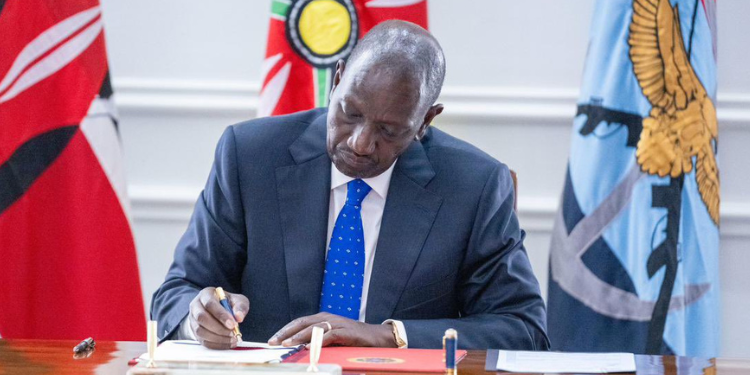
President William Ruto has signed the Judges’ Retirement Benefits Bill, 2025, into law, introducing a new contributory pension scheme for members of the judiciary in Kenya.
The new law establishes a structured retirement benefits system for judges, aimed at guaranteeing financial security after they leave office.
“The enactment of the Judges’ Retirement Benefits Act strengthens the Judiciary and reinforces its independence by guaranteeing retirement benefits and safeguarding security of tenure,” stated President Ruto.
New Contributory Pension Scheme for Judges
The newly enacted law creates a retirement benefits framework for judges serving in the Kenyan judiciary.
Also Read: Ruto Appoints 15 Judges to the Court of Appeal
Unlike previous arrangements, which relied on state pensions, the new system introduces a contributory model that involves both judges and the government.
Judges will now contribute 7.5% of their basic salary to the retirement fund.
The government, on its part, will contribute 15%, doubling the judges’ contributions.
“The new law establishes a Judges’ Retirement Benefits Fund for judges appointed after the commencement of the Act, with judges contributing 7.5 percent of their basic salary and the Government contributing 15 percent,” the statement read.
The scheme is designed to provide several post-retirement benefits, including a monthly pension, medical insurance cover, and security support for retired judges.
The aim of the scheme is to ensure judges continue to receive adequate support even after completing their judicial service.
Additional Privileges for Members of the Judiciary
Beyond the pension arrangements, the law also introduces a number of additional privileges for judges.
Among the provisions included granting of diplomatic passports to judges. Passports are meant to recognize the high-ranking status of judges and the important constitutional role they play within the government structure.
Judges will also be granted access to government airport lounges when travelling on official duties.
The move has been hailed by Kenyans, noting that it will improve life of judges after retirement.
LegitLKM, a user on X, said, “I saw Maraga using a Probox, and I was ashamed that a whole former Chief Justice can’t afford a dignified car. I’m glad that Ruto is correcting this humiliation.
Another X user, Kibet Korir, argued that “I support a strong and independent Judiciary. But independence must go hand in hand with transparency and fairness. Many Kenyans are struggling with the cost of living, so it’s important that laws granting additional benefits to public officials are clearly justified and balanced with the realities citizens face. Strengthening institutions is important but public trust comes from accountability and prioritizing the needs of the people as well.
Also Read: Salaries, Benefits and Qualifications for Court of Appeal Judges in Kenya
How much do judges earn in Kenya?
According to the gazette notice issued by the JSC in June 2025, advertising the vacancies, Judges of the Court of Appeal are entitled to a gross monthly remuneration of between Ksh775,845 and Ksh1,187,152, excluding benefits.
The pay is based on guidelines issued by the Salaries and Remuneration Commission (SRC). Judges of the Court of Appeal serve until the mandatory retirement age of 70, with an option for early retirement after attaining the age of 65, in accordance with Article 167 (1) of the Constitution.
In addition to their salaries, Court of Appeal judges are entitled to a range of benefits provided to judges under SRC guidelines.
Judges are provided with official transport, while security is offered as advised by the Inspector General of Police. They are also covered under a comprehensive medical scheme for themselves, a spouse, and up to four fully dependent children below the age of 25.
The medical cover includes inpatient benefits of up to Ksh10 million, outpatient cover of Ksh300,000, maternity cover of Ksh150,000, and Ksh75,000 each for dental and optical services.
Follow our WhatsApp Channel and X Account for real-time news updates.