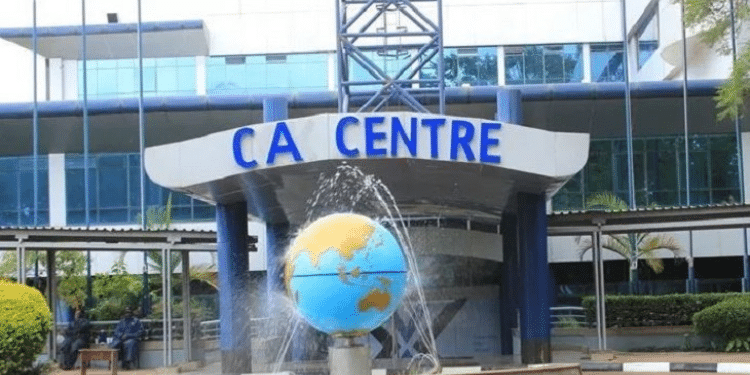
Safaricom PLC remains in the lead in Kenya’s digital economy, according to the latest quarterly data from the Communications Authority of Kenya (CA).
The Second Quarter Sector Statistics Report for the Financial Year 2025/2026 presents the performance and trends in the supply of ICT services for the period 1st October to 31st December 2025.
According to the report, the use of mobiles in Kenya is at 149.5 percent, with total SIM subscriptions hitting 78.4 million, with Safaricom maintaining the lead.
In addition, the total utilized international bandwidth in Kenya grew by 22.5 percent in the Financial Year 2025/2026.
However, the report indicates that Safaricom has declined in the metrics of SMS traffic, call durations, and pricing structures.
Safaricom SMS Decline
CA reports indicate that during the quarter, there was a decline in the Short Messaging Service (SMS) traffic in Safaricom, despite the company controlling 91.55 percent of the SMS market share.
The report showed that the company’s total SMS volume contract declined from 13.35 billion messages in the previous quarter to 13.15 billion by the end of December 2025.
Total market SMS traffic fell from 14.7 billion to 14.4 billion during the period ending in December 2025.
According to the Communication Authority, the shift is attributed to the growing uptake of internet-based messaging services, such as WhatsApp and Telegram.
Also Read: Safaricom Announces How Users Can Claim Their Birthday Bundle
Call Duration-Minutes of Use
Despite trailing its competitors in Minutes of Use (MoU) per call, Safaricom subscribers have the shortest average call duration in the country, according to the report.
Calls within the same network or the same category averaged 1.6 minutes per call, according to the company.
Telkom Kenya led the category with 2.8 minutes, followed by Airtel Networks at 2.7 minutes.
CA report on off-net traffic showed that Safaricom users averaged 1.2 minutes, while Jamii Telecommunications Ltd (JTL) subscribers enjoyed the longest conversations at 1.7 minutes.
The lag in call duration, however, did not affect the Pay-As-You-Go voice tariffs, where Safaricom led with 4.87 KES/Min in the PAYG.
Airtel had 2.93 KES/Min and Telkom 2.73 KES/Min in the tariff incentives.
Broadband and 5G Subscription
Mobile data subscriptions in Kenya grew to 61.9 million, with 83.2 percent now on broadband, as the transition from 2G and 3G networks to 4G and 5G accelerates, according to the CA reports.
Safaricom currently holds 64.3 percent of the mobile broadband market, with 5G users recording the highest average consumption at 46.4 GB per subscription, almost triple the market average of 14.6 GB.
Also Read: Safaricom Unveils AI-Powered App, Combining MySafaricom and M-PESA
Fixed Internet
With Jamii Telecommunications Limited (JTL) holding a 20.1 percent share, Safaricom has dominated the fixed internet market, with 34.9 percent of fixed data subscriptions.
On the other hand, Starlink Internet Services Kenya has a 0.9 percent market share in the total 13.9 percent q growth in subscriptions in the satellite technology.
Safaricom is now competing against satellite and terrestrial wireless solutions that are gaining traction in underserved regions of the fixed internet market.
Mobile Money
M-Pesa has continued to lead in the mobile money market, with an 89.0 percent market share in the quarter, while total mobile money subscriptions rose by 5.6 percent to 51.3 million.
Financial Year 2025/2026 ICT Indicator Categories
- Mobile Network Services.
- Fixed Network Services.
- Courier Services.
- Broadcasting Services.
- Frequency Spectrum Management.
- Electronic Transactions and Cyberspace Management.