Tuesday, June 2, 2026
  • News
    • Latest News
    • Breaking News
    • Fact Check
    • Investigations
    • Explainers
  • Politics
    • Global Politics
    • Elections
    • Government & Policy
    • Diplomacy
    • Conflicts & Security
    • Political Analysis
  • Business
    • Global Economy
    • Markets
    • Technology
    • Startups
    • Energy
    • Finance
  • World News
    • Americas
    • Asia
    • Asia Pacific
    • Africa
    • Europe
    • Middle East
  • Africa
    • Central Africa
    • East Africa
    • West Africa
    • Southern Africa
  • Health
    • Global Health
    • Public Health
    • Health Policy
    • Medical Research
    • Diseases & Conditions
    • Mental Health
    • Nutrition
    • Climate & Health
    • Health Explainers
  • Sports
    • Athletics
    • Basketball
    • Boxing
    • Cricket
    • Football
    • Formula 1
    • Golf
    • Rugby
  • Weather
    • Climate Business
    • Climate Change
    • Climate Solutions
    • Living Green
  • Culture
    • Arts
    • Film & TV
    • Food
    • Music
    • Lifestyle
    • Travel
  • Opinion
    • Editorials
    • Letters
  • Behind The Brand
REGISTER
LOGIN
No Result
View All Result
The Kenya Times
  • News
    • Latest News
    • Breaking News
    • Fact Check
    • Investigations
    • Explainers
  • Politics
    • Global Politics
    • Elections
    • Government & Policy
    • Diplomacy
    • Conflicts & Security
    • Political Analysis
  • Business
    • Global Economy
    • Markets
    • Technology
    • Startups
    • Energy
    • Finance
  • World News
    • Americas
    • Asia
    • Asia Pacific
    • Africa
    • Europe
    • Middle East
  • Africa
    • Central Africa
    • East Africa
    • West Africa
    • Southern Africa
  • Health
    • Global Health
    • Public Health
    • Health Policy
    • Medical Research
    • Diseases & Conditions
    • Mental Health
    • Nutrition
    • Climate & Health
    • Health Explainers
  • Sports
    • Athletics
    • Basketball
    • Boxing
    • Cricket
    • Football
    • Formula 1
    • Golf
    • Rugby
  • Weather
    • Climate Business
    • Climate Change
    • Climate Solutions
    • Living Green
  • Culture
    • Arts
    • Film & TV
    • Food
    • Music
    • Lifestyle
    • Travel
  • Opinion
    • Editorials
    • Letters
  • Behind The Brand
  • News
    • Latest News
    • Breaking News
    • Fact Check
    • Investigations
    • Explainers
  • Politics
    • Global Politics
    • Elections
    • Government & Policy
    • Diplomacy
    • Conflicts & Security
    • Political Analysis
  • Business
    • Global Economy
    • Markets
    • Technology
    • Startups
    • Energy
    • Finance
  • World News
    • Americas
    • Asia
    • Asia Pacific
    • Africa
    • Europe
    • Middle East
  • Africa
    • Central Africa
    • East Africa
    • West Africa
    • Southern Africa
  • Health
    • Global Health
    • Public Health
    • Health Policy
    • Medical Research
    • Diseases & Conditions
    • Mental Health
    • Nutrition
    • Climate & Health
    • Health Explainers
  • Sports
    • Athletics
    • Basketball
    • Boxing
    • Cricket
    • Football
    • Formula 1
    • Golf
    • Rugby
  • Weather
    • Climate Business
    • Climate Change
    • Climate Solutions
    • Living Green
  • Culture
    • Arts
    • Film & TV
    • Food
    • Music
    • Lifestyle
    • Travel
  • Opinion
    • Editorials
    • Letters
  • Behind The Brand
No Result
View All Result
The Kenya Times ~ Trending, Breaking News and Videos
No Result
View All Result
ADVERTISEMENT

Kenyan Protesters Are Demanding President Ruto Be Removed

What the Law Says About How That Could Happen

John Mukum MbakubyJohn Mukum Mbaku
August 9, 2024
Reading Time: 8 mins read
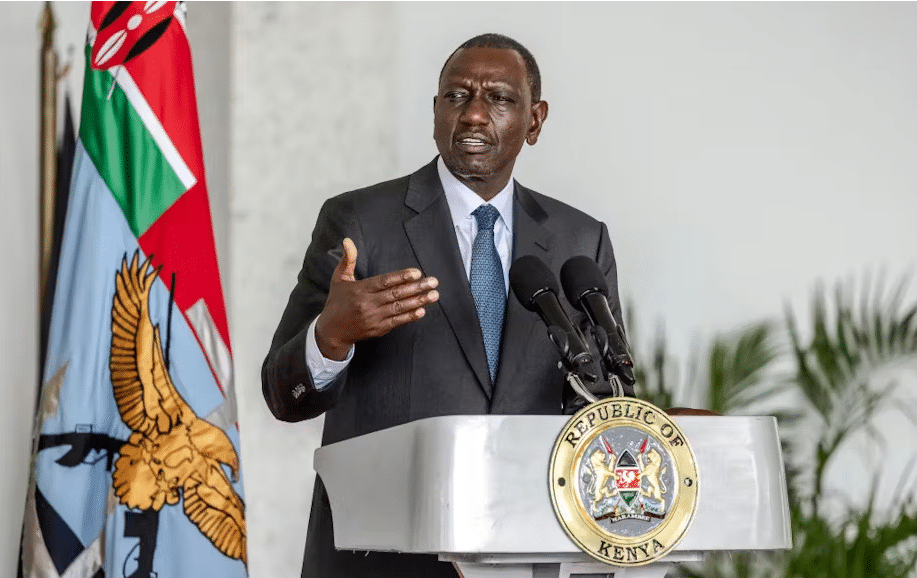
President Of Kenya William Ruto At State House, Nairobi. Luis Tato/Afp Via Getty Images

President of Kenya William Ruto at State House, Nairobi. Luis Tato/AFP via Getty Images

FacebookTwitterLinkedInRedditWhatsApp
Advertisement

In June 2024, many Kenyans took to the streets to protest what they believed were punitive taxes imposed by President William Ruto’s government. Though the president caved in and withdrew the contentious Finance Bill 2024, protesters are unmoved and now insist that he leave office.

No Kenyan president has ever been removed prematurely from office.

The opposition, led by the Azimio La Umoja Coalition, set out to collect 10 million signatures in 2023. This was part of an effort to pressure Ruto to step down. This signature-gathering effort, however, has no constitutional relevance to the removal of a Kenyan president from office.

Kenya’s democratic constitution is quite clear on how a sitting president can be removed from office. As a legal expert and economist who studies the rule of law and democratization in Africa, I outline what the law says about how Ruto could, in theory, be removed from office.

The constitution of Kenya guides the process. There are only two legal routes to remove a president before the end of his or her term: on the grounds of incapacity (Article 144) or impeachment (Article 145).

The process can be lengthy and complicated. However, as Kenya is a democracy, those who believe that Ruto has failed them as president can deny him a second term in the country’s next general election in 2027.

Removal on grounds of incapacity

The removal of a president from office because he or she no longer has the physical or mental capacity to perform the functions of the office may be carried out by a majority of the 349 members of the Kenyan national assembly, which is one of two houses of parliament.


Also Read: Questions as Police Surround Jimi Wanjigi’s Home Amid Nane Nane Protests


First, a member of the national assembly, who is supported by at least 25% of all the members, can move a motion to investigate the president’s physical or mental capacity to perform his or her constitutional functions.

If that motion is supported by a majority of all members of the national assembly, then the speaker can inform the country’s chief justice of the resolution within two days.

After receiving notice of the resolution, the chief justice or deputy chief justice has seven days to appoint a special tribunal to investigate the matter.

The special tribunal must consist of five individuals. These are three qualified Kenyan medical practitioners, one advocate of the high court and an individual nominated by the president.

The report of the tribunal must be submitted to the chief justice and the speaker of the national assembly within 14 days. The report is considered final and is not subject to appeal (Article 144(8)).

The speaker must then table the report before the national assembly within seven days.

If the tribunal concludes that the president doesn’t have the capacity to perform the functions of his or her office, the national assembly must vote on whether to ratify the report. If the majority vote to ratify the report, this will automatically result in the president’s removal from office.

Removal by impeachment

A member of the national assembly may move a motion to impeach a sitting president. The motion must be supported by at least one third of all members (Article 145(1)).

A sitting president may be impeached

  • on the ground of a gross violation of a provision of the constitution or of any other law
  • where there are serious reasons for believing that the president has committed a crime under national or international law
  • for gross misconduct.

If the motion to impeach the president is supported by at least two-thirds of all 349 members of the national assembly (or at least 232 members), the speaker then transmits the resolution to the speaker of the senate (the upper house of parliament) within two days.


Also Read: How DCI Trapped and Abducted Blogger Over Nane Nane Protests


Within seven days of receiving the notice of the impeachment resolution from the speaker of the national assembly, the speaker of the senate must call the senate to order to hear and investigate the charges against the president.

The senate may pass a resolution to appoint a special committee, which is made up of 11 of its members, to investigate the charges against the president. The special committee has 10 days to investigate the matter and report to the senate.

The president and his or her legal counsel are allowed to appear before the special committee during investigations. If the special committee determines and reports to the senate that

the particulars of any allegation against the President — (a) have not been substantiated, further proceedings shall not be taken under Article 145 in respect of that allegation; or (b) have been substantiated, the Senate shall, after according the President an opportunity to be heard, vote on the impeachment charges.

If at least two-thirds of the 67 members of the senate vote in favor of upholding any of the impeachment charges, the president’s mandate will be terminated.

The likelihood of the opposition securing the numbers needed to get these processes going are slim. Presently, of the 349 seats in the national assembly, 179 are held by the government, 158 by the opposition and 12 by independents. In the senate, the government and opposition each hold 33 seats, with one seat being vacant.

Once a president is removed

What would happen should the senate convict and remove the president from office? The constitution says the deputy president shall assume office for the remainder of the term of the president (Article 146(2)).

However, if the deputy president is unable to assume the office of president, the speaker of the national assembly shall serve as president. An election for president must then be held within 60 days after the vacancy is created (Article 146(2)(b)).

Democracy and the rule of law

To safeguard against opportunistic interference with the ability of a democratically elected president to perform his or her functions, Kenya’s constitution defines and enshrines very specific grounds for the removal of a sitting president.

Popular discontent or dissatisfaction with the performance of the president isn’t one of these grounds.

The mass protests against the Ruto regime are an expression of Kenyans’ frustration and dissatisfaction with the performance of their government.


Also Read: Nane Nane Protests: US Embassy Issues Advisory to Americans


While Kenyans, through their elected officials, have the tools to terminate the president’s mandate early, they might want to seriously consider the consequences this would have on their democracy in general and future administrations in particular.

Ruto has been in office for less than two years. Civil society and the protest movement might want to adopt a more constructive approach that seeks increased participation in policy design and implementation. Additionally, Kenyans can exercise their right to oust the regime in 2027 by denying it the votes that it needs to be re-elected.The Conversation

John Mukum Mbaku, Professor, Weber State University

This article is republished from The Conversation under a Creative Commons license. Read the original article.

Tags: Constitution of KenyaImpeachmentKenyaKenya ProtestsNational AssemblyWilliam Ruto
John Mukum Mbaku

John Mukum Mbaku

John Mukum Mbaku is a Brady Presidential Distinguished professor of economics and John S. Hinckley Fellow at Weber State University. He is also a nonresident senior fellow at The Brookings Institution in Washington, D.C., and an attorney and counselor at law, licensed to practice in the Supreme Court of the State of Utah, the U.S. District Court for the District of Utah, and the U.S. Supreme Court. He received his PhD in economics from the University of Georgia and his JD in law and graduate certificate in natural resources and environmental law from the S. J. Quinney College of Law at the University of Utah. He is a resource person for the Kenya-based African Economic Research Consortium. Professor Mbaku also holds a B.S. (Chemistry) from Berry College (Mount. Berry, Georgia), a B.A. (French Language and Literature) from Weber State University (Ogden, Utah), and an International MBA (IMBA) from the University of South Carolina. His research interests are in public choice, constitutional political economy, sustainable development, law and development, international human rights, intellectual property, rights of indigenous groups, women and children, trade integration and institutional reforms in Africa. Mbaku is the author of Corruption in Africa: Causes, Consequences, and Cleanups (Lexington Books, 2010) and (with Mwangi S. Kimenyi) of Governing the Nile River Basin: The Search for a New Legal Regime (The Brookings Institution Press, 2015) and Protecting Minority Rights in African Countries: A Constitutional Political Economy Approach (Edward Elgar, 2018). On May 22, 2017, John Mukum Mbaku, was admitted and qualified as an Attorney and Counsellor of the Supreme Court of the United States. At Weber State University, John Mukum Mbaku teaches courses in principles of economics, intermediate microeconomics, international trade, business calculus, and economic development. He also works with international students and helps them adjust to college life in the United States. Professor Mbaku also engages with community groups and helps them understand issues such as globalization, outsourcing, and immigration and how they affect economic activities in the United States. Professor Mbaku also visits local schools to talk to students about the U.S. constitution, constitutionalism and the rule of law in the United States and other countries. He is a consultant to several domestic and international news organizations, as well as multilateral organizations (e.g., the African Development Bank), on governance issues in Africa and has appeared on several domestic and international news programs to discuss elections, corruption, sustainable management of natural resources, including water, and various governance-related issues in Africa.

Related Posts

Treasury Invites Applications For Board Recruitment Across 39 State-Owned Enterprises

Opinion | How New Taxes on Bank Card Transactions Charges Will Raise the Costs for Ordinary Kenyans if Adopted by Parliament

June 1, 2026
Artificial Intelligence Esther Muoria Is A Seasoned Manager And Phd Holder Appointed By President William Ruto As The Tvet Principal Secretary.

Opinion | AI Mistakes That Could Destroy Kenya’s Future — Global Lessons Every Leader, Business and Citizen Must See Now

May 31, 2026
Health Cs Aden Duale Denies Claims Sha Will Shut Down. Ebola Storm Rages On

Opinion | Kenya Should Think Before Rejecting the Laikipia Ebola Facility

May 31, 2026
Low Wages Squeeze Kenyans As As Computer Misuse And Cybercrimes Act Establishes Penalties For Unauthorized Access To Computer Systems, As Well The Legal Cybersecurity Practices.

Opinion | Why Wage Increases Won’t Fix What’s Broken in Kenya’s Economy

May 29, 2026
ADVERTISEMENT

The Kenya Times Facebook

LATEST ARTICLES

  • Nairobi Mentioned as Trump Cut Number of Embassies in Africa
  • Why Transgender Troops Can Now Serve in the U.S. Military
  • “I Couldn’t Care Less” Trump Responds After Iran Ends Talks With US
  • Jill Biden Reveals Regret Over Joe Biden’s 2024 Run in New Interview
  • Stars Abroad: Moses Shumah, Kenyan Striker Breaking Records in Zambia
  • Doctors Question Transparency of Trump’s Heart Test Results
  • Corazone Aquino: Kenyan Star Named After Philippines’ Former President
  • KMA Reveals How to Know Licensed Doctors After Deadly Kitale Surgery
  • Iran Ends All Negotiations With US, Vows to “Completely” Block the Strait of Hormuz
  • Wise vs Remitly vs Western Union: Best International Transfer in 2026
  • KDF Soldiers Take Charge as Protests Erupt in Nanyuki Over Ebola Quarantine Facility
  • End of an Era as Paris Lounge & Grill Rebrands, Kentwood Address Undergoes Renovation
  • Benny McCarthy Makes Changes to Harambee Stars Squad Days After Unveiling 24 Players
  • Ruto Delivers Weighty Apology During Madaraka Day Speech [FULL TEXT SPEECH]
  • Njeri Maina Explains Why President Ruto Can’t Be Impeached
ADVERTISEMENT

Company

About Us

Our Authors

Our Experts

Social Media

Policies

Privacy Policy

House Rules

Standards and Policies

Terms and Conditions

Subscription

My Account

Contact Us

Contact Us

Join Our Team

Advertise With Us

© Copyright 2026 | The Kenya Times | All Rights Reserved

Welcome Back!

Sign In with Facebook
Sign In with Google
Sign In with Linked In
OR

Login to your account below

Forgotten Password? Sign Up

Create New Account!

Sign Up with Facebook
Sign Up with Google
Sign Up with Linked In
OR

Fill the forms below to register

All fields are required. Log In

Retrieve your password

Please enter your username or email address to reset your password.

Log In
Your Privacy and Cookies
We use cookies on our website to give you the most relevant experience by remembering your preferences and repeat visits. By clicking “Accept”, you consent to the use of ALL the cookies.
Do not sell my personal information.
Cookie settingsACCEPT
Privacy & Cookies Policy

Privacy Overview

This website uses cookies to improve your experience while you navigate through the website. Out of these cookies, the cookies that are categorized as necessary are stored on your browser as they are essential for the working of basic functionalities of the website. We also use third-party cookies that help us analyze and understand how you use this website. These cookies will be stored in your browser only with your consent. You also have the option to opt-out of these cookies. But opting out of some of these cookies may have an effect on your browsing experience.
Necessary
Always Enabled
Necessary cookies are absolutely essential for the website to function properly. This category only includes cookies that ensures basic functionalities and security features of the website. These cookies do not store any personal information.
Functional
Functional cookies help to perform certain functionalities like sharing the content of the website on social media platforms, collect feedbacks, and other third-party features.
Performance
Performance cookies are used to understand and analyze the key performance indexes of the website which helps in delivering a better user experience for the visitors.
Analytics
Analytical cookies are used to understand how visitors interact with the website. These cookies help provide information on metrics the number of visitors, bounce rate, traffic source, etc.
Advertisement
Advertisement cookies are used to provide visitors with relevant ads and marketing campaigns. These cookies track visitors across websites and collect information to provide customized ads.
Others
Other uncategorized cookies are those that are being analyzed and have not been classified into a category as yet.
SAVE & ACCEPT
LOGIN | REGISTER
  • Login
  • Sign Up
  • Cart
No Result
View All Result
  • News
    • Latest News
    • Breaking News
    • Investigations
    • Explainers
    • Fact Check
  • Politics
    • Global Politics
    • Conflicts & Security
    • Elections
    • Diplomacy
    • Government & Policy
    • Political Analysis
  • Business
    • Global Economy
    • Markets
    • Technology
    • Startups
    • Energy
    • Finance
  • World News
    • Americas
    • Asia
    • Asia Pacific
    • Africa
    • Europe
    • Middle East
  • Africa
    • East Africa
    • West Africa
    • Southern Africa
    • Central Africa
  • Health
    • Global Health
    • Public Health
    • Health Policy
    • Medical Research
    • Diseases & Conditions
    • Mental Health
    • Nutrition
    • Climate & Health
    • Health Explainers
  • Sports
    • Athletics
    • Basketball
    • Boxing
    • Cricket
    • Football
    • Formula 1
    • Golf
    • Rugby
  • Weather
    • Climate Business
    • Climate Change
    • Climate Solutions
    • Living Green
  • Culture
    • Arts
    • Film & TV
    • Food
    • Lifestyle
    • Music
    • Travel
  • Opinion
    • Editorials
    • Letters
  • Behind The Brand
  • Contact Us

Not enough quota to unlock this post
Unlock left : 0
Are you sure want to cancel subscription?