
It’s raining. Across Nairobi, hardworking Kenyans are rushing home from work. Mama mbogas hurriedly folds the mats where her produce lay. The city dims as clouds thicken.
At the bus stop, you stand in a queue, sharing an umbrella with a stranger. One hour later, you finally board a matatu. The rain intensifies, traffic grinds to a halt, and the cold creeps in. Your phone is at 8%.
You hesitate—do you check what’s trending on X, or see what Kawangware Finest has posted about nuclear energy?
You choose survival first: pay the fare via mobile money before the phone dies.
That everyday hustle tells a deeper story: energy is not a luxury—it is survival.
Kenya’s President William Ruto recently mentioned that Kenya is experiencing power rationing, and many were shocked. Some dismissed it outright. But the reality is more complex.
As of mid-2025, Kenya has an installed electricity capacity of approximately 3,840.8 MW. Over 90% of this comes from renewable sources—primarily geothermal (47%), hydro (21%), wind, and solar. Peak demand stands at around 2,439 MW.
The question is simple: Is this enough for a country pushing toward industrialisation and an AI-driven future that demands constant, uninterrupted power?
The honest answer: No.
So, what next?
We cannot afford a future of endless blackouts, where Kenyans flood timelines questioning outages and shouting “hatuna power.” The economy cannot scale on uncertainty.
Across Africa, a growing number of countries are turning to nuclear energy as part of their long-term solution. Kenya is not being left behind.
Also Read: KenGen Joins the Silicon Savanah’s Nuclear Relay Team
Through the Kenya Nuclear Power and Energy Agency (NuPEA), feasibility studies and site assessments—including in Siaya County—have already been undertaken.
President Ruto has set an ambitious target of 10,000 MW to power Kenya into a first-world economy.
The first nuclear plant is projected to generate approximately 2,000 MW, with plans to scale up to 6,000 MW over time.
A key milestone has already been achieved.
The Kenya Electricity Generating Company (KenGen) and the nuclear agency recently signed a landmark Memorandum of Understanding establishing a Joint Engagement Framework. This is one of the most comprehensive public engagement efforts in Kenya’s energy history—designed to build trust, awareness, and national readiness.
As KenGen Managing Director and CEO Peter Njenga noted, nuclear energy is the next frontier for nations seeking stable, affordable, low-carbon baseload power. Designating KenGen as the owner-operator leverages its operational depth and public trust.
This is not just communication—it is national preparation.
For ordinary Kenyans and investors, this translates into something tangible: more predictable tariffs, fewer outages, and an energy ecosystem capable of supporting advanced manufacturing and digital industries.
At the continental level, the Nuclear Energy Agency is working with African nations to unlock sustainable economic development through nuclear policy and cooperation.
This momentum converges in Nairobi.
Nuclear Conference in Nairobi
The International Conference on Nuclear Energy (ICoNE) 2026 will bring together governments, regulators, experts, and global institutions to explore how nuclear energy can power Africa’s future.
Jointly hosted by the NEA, NuPEA, the U.S. Department of State’s FIRST Programme, and Korea Hydro & Nuclear Power, the conference will take place in Nairobi from 24–26 March 2026.
As William D. Magwood IV notes, nuclear energy has the potential to meet Africa’s energy needs while advancing sustainable development and improving lives.
NuPEA CEO Justus Wabuyabo emphasizes that the conference will foster meaningful dialogue on how to deliver reliable, clean, and affordable electricity.
Also Read: Why Raila’s Last Wish on Nuclear Energy Should Be Honored
And according to Insik Park, Africa can benefit from global experience—especially from countries like South Korea that have successfully leveraged nuclear power for economic growth.
The theme is clear: Harnessing nuclear energy for Africa’s development.
From that rain-soaked commute to the factory floor, from the farmer’s irrigation needs to the data centers powering AI, energy is the thread that connects it all.
Kenya stands at a crossroads.
The choices made today will define whether the country powers its future—or struggles to keep the lights on.
Don’t miss the International Conference on Nuclear Energy (ICoNE) 2026.
Mark the dates. “Opinion is free, but facts are sacred.”
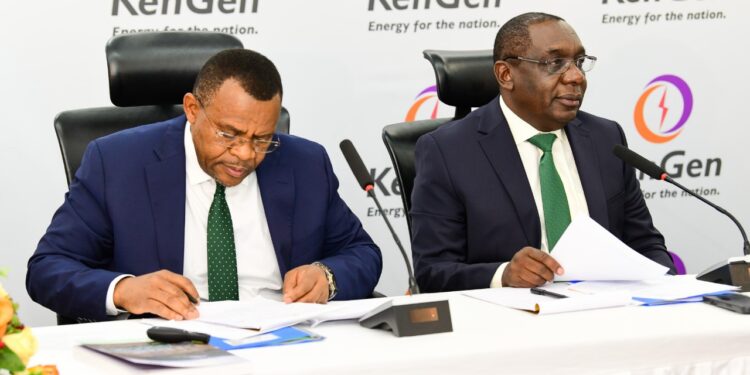
KenGen CEO Peter Njenga (left) with former Board Chairman Alfred Agoi at a past event. PHOTO/KenGen.