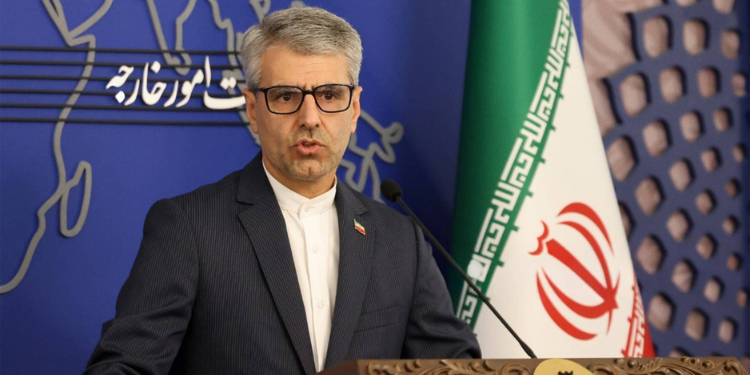
Iran has called on the American public to demand accountability from the US government over what it describes as an illegal and unprovoked war against the country.
In a statement on May 1, Iranian Foreign Ministry spokesperson Esmaeil Baghaei said Americans have an “undeniable right and a solemn duty” to question the Trump administration over the US‑Israeli military campaign against Iran, which he labeled a “war of choice.”
Baghaei said the conflict amounted to “a clear, unprovoked act of aggression” and accused Washington of violating international law.
He added that the US public should challenge their government not only for launching the war, but also for what he described as atrocities committed during the campaign.
“Waging this illegal war against the nation of Iran must not go unquestioned,” Baghaei said, according to comments shared on social media by Iran’s Foreign Ministry.
Iran Circulates US Senate Remarks Questioning War Rationale
Baghaei circulated video footage of US Senator Kirsten Gillibrand speaking during a recent Senate hearing, in which she questioned the justification for military action against Iran.
In the clip, Gillibrand said no evidence had been presented to support claims that Iran posed an imminent threat to the United States.
“We did not have any evidence that Iran intended to imminently attack this country in any way, shape or form,” Gillibrand said during the hearing.
Also Read: Iran Suffers Huge Blow as Trump Admin Pulls Off Another Card Amid Ceasefire
Iran has repeatedly argued that claims of an imminent threat were used to justify military action without sufficient proof, insisting that it did not seek confrontation and that the attacks were carried out without provocation.
Origins of the Conflict
The military campaign Operation Epic Fury (US) and Operation Roaring Lion (Israel) began on February 28, 2026.
US and Israeli forces conducted large‑scale airstrikes targeting Iranian missile sites, air defenses, military infrastructure, nuclear‑related facilities, and leadership targets.
The military campaign began on February 28, 2026, when US and Israeli forces launched large‑scale airstrikes that, in the opening phase, killed Supreme Leader Ali Khamenei, IRGC commander Hossein Salami, and other military and political figures.
The Trump administration and Israel said the operation was carried out in self‑defense, citing Iran’s nuclear activities, missile program, backing of allied armed groups in the region, and what they described as an imminent threat.
Washington framed the campaign as part of a confrontation with Iran, carried out in collective self‑defense with Israel.
Iran maintains that the strikes were unprovoked and occurred while nuclear negotiations mediated by Oman and other parties were ongoing and reportedly nearing progress.
Also Read: Collins Breaks With GOP as 60-Day Iran Deadline Looms, Votes to End Hostilities
Humanitarian Costs and Regional Fallout
The conflict escalated into a regional confrontation, featuring Iranian retaliatory missile and drone attacks, disruptions to global shipping through the Strait of Hormuz, and widespread civilian consequences.
Thousands were killed, primarily Iranian civilians, with millions displaced and widespread infrastructure damage reported.
One of the major incidents occurred on the first day of the campaign, February 28, 2026, when a US missile struck the Shajareh Tayyebeh Elementary School in Minab, killing approximately 156–175 people, including around 120 schoolchildren, most of them girls.
The war also had global economic effects, with disruptions to the Strait of Hormuz, one of the world’s most critical oil chokepoints, driving oil prices higher and briefly pushing them past $120 per barrel.
A temporary ceasefire was announced in April 2026, though tensions remain over maritime security, reconstruction, and stalled diplomatic efforts.
Growing Domestic Criticism in the US
The war has drawn strong domestic criticism in the United States. A Washington Post–ABC News–Ipsos poll found that 61 percent of Americans believe it was a mistake for President Trump to launch military action against Iran.
During the Senate hearing referenced by Baghaei, Senator Gillibrand pressed Defense Secretary Pete Hegseth on public opposition to the war.
“Three out of five Americans are against this war today,” Gillibrand said. “Why do you continue to prosecute a war that the American people aren’t behind?”
She also questioned the administration’s evidentiary basis for the strikes and its compliance with the War Powers Resolution.
Iran says its latest statement shows a consistent position that the conflict was avoidable and driven by external political agendas rather than legitimate self‑defense.
The US administration maintains that the operations substantially weakened Iran’s military capabilities and prevented a nuclear breakout.