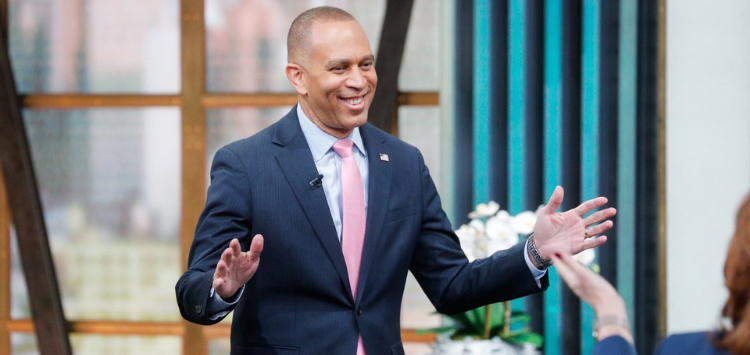
House Minority Leader Hakeem Jeffries said President Donald Trump shows “signs of decay” and needs a wellness check, pointing to the president’s social media activity and long-running attacks on Barack Obama and other opponents.
Jeffries made the comments on Thursday, May 14, as Trump wrapped up a high-stakes summit in Beijing with Chinese President Xi Jinping.
The Democratic leader accused Trump of focusing on personal feuds while the country deals with higher gas prices and the ongoing war with Iran.
“The American people absolutely should be deeply concerned,” Jeffries said. “We need a wellness check on this guy. He continues to exhibit signs of decay.
President’s Social Media Activities Raise Eyebrows
He described Trump’s recent social media posts as an “unhinged” outburst filled with conspiracy theories aimed at Obama. Jeffries said Trump suffers from “Obama derangement syndrome” and still acts like he won the 2020 election.
“Something is really wrong with this guy, which is why I’ve publicly called for a wellness check, an intervention,” Jeffries added.
The remarks came during a period of sharp partisan fighting. Trump has posted frequently about Jeffries, calling him “low IQ” and criticizing his positions on voting rights and other issues.
Jeffries said the president targets him almost daily, sometimes multiple times a day, and wondered whether he gets time to think about what Americans are facing, such as rising gas prices.
Jeffries slammed Trump’s handling of domestic problems, describing the economy as a “disaster,” said gas prices have skyrocketed, and called the conflict in the Middle East a “reckless and costly war of choice.”
Gas prices have climbed sharply since the U.S. and Israel launched strikes on Iran in late February. The national average now sits near $4.50 a gallon, up more than $1.50 from before the conflict began.
Disruptions in the Strait of Hormuz have tightened oil supplies and pushed inflation higher. The Pentagon says the war has already cost nearly $30 billion.
Trump has proposed pausing the federal gas tax to ease the burden on drivers. He argues the military action was necessary to stop Iran from building nuclear weapons and to weaken its proxies across the region.
Major Summit in China
The president traveled to China this week with a group of American business leaders, including tech executives.
The agenda included trade deals, artificial intelligence rules, tensions over Taiwan, and possible Chinese help with the Iran situation. Trump and Xi held talks and attended a state banquet in Beijing.
Jeffries criticized the trip, calling it a mistake that made the U.S. look weak. He accused Trump of “bending the knee” to the Chinese Communist Party while Americans struggle at home.
This is not the first time Jeffries has raised questions about Trump’s mental sharpness. Earlier this year, he called for more transparency on the president’s health.
Trump, who is 79, has shared glowing reports from White House doctors and has mocked critics who raise his age.
Also Read: Trump Waives $15,000 Visa Bonds for World Cup Fans from 50 Countries
With midterm elections approaching later this year, Democrats want to tie Trump to higher prices and the human and financial costs of the Iran conflict.
Republicans say the president is delivering on national security and blame global events for economic pain.
Jeffries has vowed to mobilize voters ahead of the November midterm elections to make sure Democrats win and become the House majority, and use their numbers to check and stop some of the policies Trump is advancing.
Obama Policies Called Out
Trump has not directly responded to the latest demand for a wellness check, but he has continued his pattern of posting about political opponents.
In recent days, he revisited old grievances from the 2016 and 2020 campaigns and criticized Obama-era policies.
Meanwhile, the war in Iran remains the central issue hanging over everything. Ceasefire talks have made some progress, but energy prices show no sign of dropping soon.
The political battles ahead could be shaped by how voters feel about the conflict and its impact on their pocketbooks.