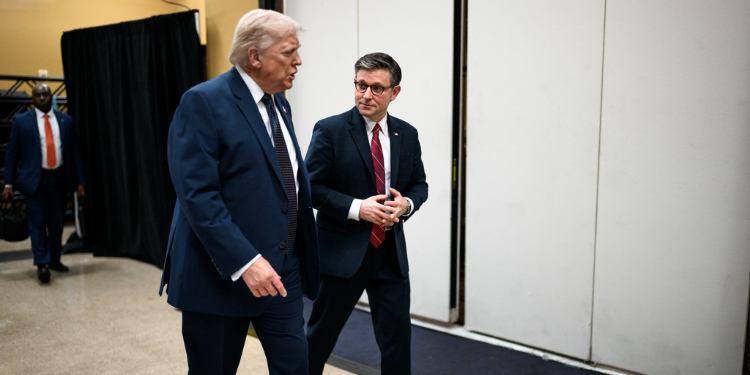
House Speaker Mike Johnson said Wednesday, June 24, that he plans to include the Safeguard American Voter Eligibility (SAVE) America Act in a third budget reconciliation package as part of his quest to push the election-integrity measure past Senate roadblocks.
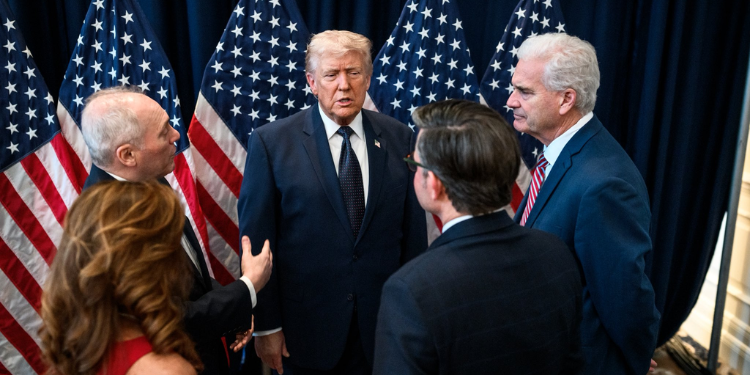
Johnson made the comments after President Trump pulled back from signing a bipartisan housing bill, pressing instead for action on voter requirements.
The SAVE America Act would require proof of U.S. citizenship to register for federal elections and a photo ID to cast a ballot.
It passed the House earlier this year but has gone nowhere in the Senate, where Democrats oppose it, and it lacks the votes to beat a filibuster.
Johnson Pushes Reconciliation Strategy to Advance SAVE America Act
In a press briefing, Johnson told reporters he had spoken with Trump that morning about using reconciliation to get it done.
“The only path, I think, to get that done, because you’re never going to get seven Democrats to join 53 Republicans in the Senate to do that … you have to put it on a reconciliation bill,” he said.
Johnson described tying the measure to a grant program for states. Blue states could tap federal funds if they adopt election-integrity measures such as photo ID requirements.
“We believe that if you create a grant program that ties it to reconciling the budget, and you allow blue states, if they come to their senses and they want to avail themselves of election integrity proposals, ideas, and policies, they can draw down from a federal fund, and use those funds. We’re willing to invest heavily in that,” he explained.
Why Republicans See Reconciliation 3.0 as Their Best Path Forward
He added that House Republicans would build “reconciliation 3.0” around the idea. “House Republicans will put together a reconciliation bill, reconciliation 3.0, that will have that,” Johnson said.
He noted Trump wanted to see progress: “The president said, ‘I want to see some progress on it.’ I said, ‘I’d love to show it to you.’”
Johnson planned meetings later Wednesday with House Republicans to discuss what else might go into the package.

This comes as Republicans have already moved two reconciliation bills this year. The latest one funded border security measures.
A third round would give them another shot at priorities that can’t clear the regular 60-vote Senate threshold.
The SAVE Act has strong backing from Trump and many Republicans, who call it essential to stop non-citizens from voting and restore trust in elections.
Supporters point to gaps within current rules that rely on self-attestation for citizenship in many places.
Also Read: Trump Refuses to Sign Housing Bill Until Senate Passes SAVE Act
Only about 36 states require photo ID for voting, they note, and proof of citizenship is not uniformly enforced.
Democrats and voting rights groups argue the bill would create unnecessary hurdles for millions of eligible citizens, especially those without easy access to passports or birth certificates.
They say it amounts to voter suppression dressed up as integrity. Senate Majority Leader John Thune has pushed back against changing or scrapping the filibuster to pass it outright.
Even some on the right have doubts about the reconciliation route. The Senate parliamentarian ruled earlier that core parts of the SAVE Act do not meet the Byrd Rule standards for budget reconciliation.
That rule keeps policy changes from sneaking into these bills if their budget impact is only incidental.
Rep. Anna Paulina Luna, a Florida Republican, voiced skepticism on X: “The Save America Act cannot be placed in reconciliation, and I’m not drinking the Kool-Aid. Neither should you.”
Also Read: New DHS Chief Signals Hardline Shift on Voting, Claims 80% Support SAVE America Act
Johnson’s team is trying to work around that by describing the provisions through federal grants and spending that tie directly to the budget.
Similar attempts have faced challenges before, including an effort to add SAVE-like language to an earlier budget resolution that failed in the Senate.
A bipartisan housing package passed the Senate overwhelmingly and now sits on Trump’s desk. Without his signature, it could become law in 10 days on its own.
Trump canceled a planned signing event, using the window to demand movement on the voter bill.
House Republicans are seeing the reconciliation push as a way to show concrete steps.
The SAVE Act, formally H.R. 7296, or earlier versions such as H.R. 22, passed the House in February by a narrow margin, with nearly all Democrats voting no.