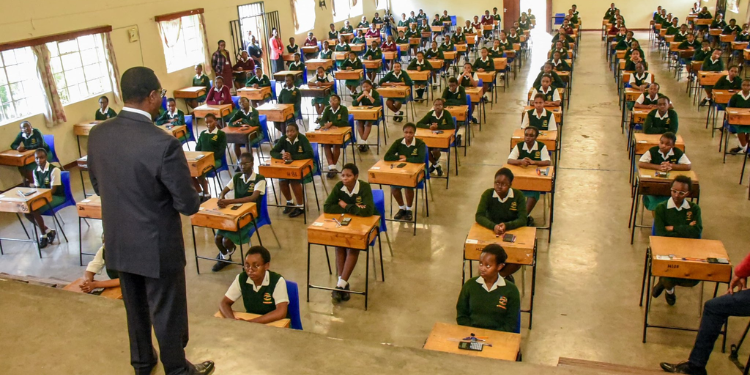

Kenyans who wish to sit for the Kenya Certificate of Secondary Education (KCSE) exams without being enrolled in regular secondary schools have the opportunity, but must first register as private candidates.
This category includes adults learner as well as repeaters—students who have previously sat for the KCSE and wish to improve their grades.
All Adult learners (above 24 years of age) must register as private candidates.
Private candidates in Kenya are registered at their respective Sub-County Directors of Education (SCDE) offices.
Candidates can repeat the entire KCSE exam (seven or more subjects) or a portion of it (fewer than seven subjects), regardless of when they previously sat the exam, provided they have proof of prior participation.
Full repeaters register under Entry Code 2, while partial repeaters use Entry Code 3.
Theory and practical papers are taken at county headquarters in centres designated by the County Directors of Education, while project work is administered at sub-county institutions identified by the SCDEs.
KNEC allows only one private examination centre per sub-county, where candidates undertake their projects, with all other exams held at the county headquarters.
Access to examination centres requires proof of eligibility, including a National ID, birth certificate, or passport.
Candidates are responsible for confirming their registration details, ensuring the accuracy of their data, and obtaining information on rehearsal and examination venues.
KCSE Private Candidates: Entry Requirements
To register for the KCSE examination as a private candidate in Kenya, applicants must meet the following requirements:
Holders of a valid KCPE certificate, EACE, KCE, or a foreign qualification accompanied by a KNEC equivalence letter.
Alternatively, a primary certificate other than KCPE (CPE or foreign), along with a KNEC KCSE Qualifying Test result slip showing a pass.
Evidence of having spent at least three years after sitting for the primary examinations before registering for KCSE.
A letter from the SCDE or headteacher of the approved private candidate examination centre where practical examination papers will be taken.
A National Identity card, passport, or alien card for foreign candidates. If unavailable, a birth certificate along with proof of application for a National ID (waiting card) is required.
Download and complete the private candidates’ registration form from the KNEC website (www.knec.ac.ke) before reporting to the SCDE for further instructions.
Private candidates are required to pay an examination fee of Ksh 7,200, which is the responsibility of the individual candidate.
Payment is mandatory for successful registration and must be made at the point of registration.
Fees are paid online through E-Citizen, following the instructions provided on the KNEC registration platform.
Also Read: How Students Can Qualify to Sit For KCSE Exams Without KCPE Certificate
Subjects with Projects
Candidates entering for French, German, Arabic, and Music should take note of the early dates for aural and oral examinations, which will be conducted only at specific centres arranged at the sub-county level.
Those registered for subjects with project papers should be aware that projects will be administered within time frames provided by KNEC.
Dates for project, oral, aural, and practical assessments will be communicated separately and will also appear on the printed KCSE timetable.
During this period, candidates are required to prepare their projects at the school hosting them for the practical examination.
Also Read: Crucial Dates and Full Timetable of KJSEA 2026; What Parents Should Know
Guidelines on Repeaters
There are two categories of repeaters for the KCSE examination:
- Repeaters Taking 7 or More Subjects
Candidates wishing to improve their mean grade must repeat the entire examination, registering for a minimum of 7 subjects and a maximum of 9 subjects, in line with subject entry requirements.
They must adhere to all regulations for certificate award criteria.
These candidates are assigned regular index numbers (001–499) and may re-sit the examination as many times as they wish, provided they continue to meet the entry requirements.
- Repeaters Taking Fewer Than 7 Subjects
Candidates may repeat 1 to 6 subjects only, and can do so once, provided the subjects are part of the current curriculum and were previously sat for in their first examination attempt.
New subjects not taken in the first attempt cannot be introduced.
These candidates are assigned index numbers ending with 501, 502, etc.
They will receive a supplementary result slip showing only the grades for the repeated subjects. These grades will not affect the mean grade from their previous KCSE attempt.
Candidates in this category can sit for exams regardless of the year they first took the KCSE, as long as they comply with the subject restrictions.
All candidates MUST report to the Sub-County Director of Education (SCDE) to sign the nominal roll and to verify their registration details after the closure of the registration period.
Kenya is phasing out the 8-4-4 system following the introduction of the Competence-Based Education (CBE).
The last cohort will sit the national test in 2027.