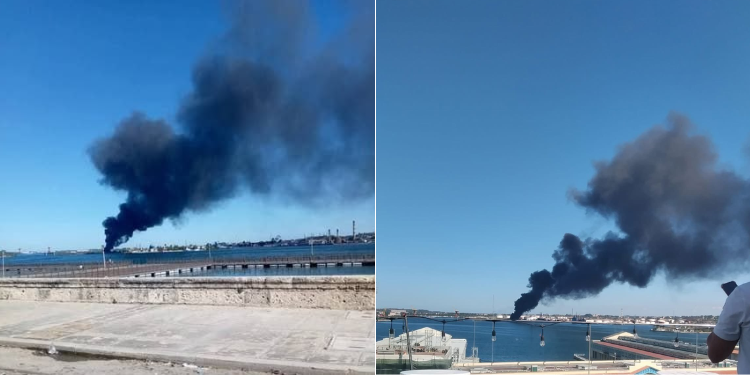
A major fire has broken out at one of Cuba’s most critical energy facilities, sending thick black smoke billowing across the skyline of Havana and deepening fears over the island’s already fragile fuel supply.
Authorities confirmed that the Friday, February 13, blaze erupted at the Ñico López Oil Refinery, a key installation in Cuba’s fuel distribution network.
The cause of the fire remains unknown, and officials have yet to confirm whether the flames reached the refinery’s vital oil storage tanks.
Videos circulating on social media showed a towering column of smoke rising over Havana Bay as emergency crews scrambled to contain the incident.
The refinery fire comes at a time the island nation is already grappling with severe fuel shortages, prolonged power outages, and reduced oil imports.
Cuba has been struggling to maintain steady fuel supplies after a dramatic geopolitical shift in the region cut off one of its main sources of crude.
Two Mexican navy ships carrying more than 800 tons of humanitarian aid had arrived at the same harbor just a day before the fire.
The shipments included essential supplies meant to ease shortages that have affected food, medicine, and electricity production across the island.
Also Read: Trump Mocks Russia, China Weapons Over Failed Defenses in Maduro Raid
Cuba’s fuel situation has deteriorated sharply in recent months following escalating pressure from President Donald Trump and the United States, which has tightened restrictions on oil flows to Havana.
The crisis intensified after Washington cut off Venezuelan crude shipments that had long sustained Cuba’s energy sector.
For years, Venezuela served as Cuba’s primary oil lifeline, supplying heavily subsidized fuel critical for electricity generation and transportation.
That pipeline however collapsed after U.S. forces captured Venezuelan leader Nicolás Maduro in January this year. The loss of Venezuelan crude has pushed Cuba’s oil stocks to dangerously low levels.
Analysts estimate the island requires roughly 100,000 barrels of crude oil per day to maintain basic operations, a target it has increasingly struggled to meet.
Washington has also warned that any country supplying oil to Cuba could face tariffs and penalties, further isolating Havana from global energy markets. The tightening pressure has fueled fears of prolonged blackouts and economic contraction.
Emergency measures across Cuba
In response to the worsening fuel crisis, President Miguel Díaz-Canel imposed sweeping emergency restrictions aimed at preserving essential services and conserving dwindling fuel reserves.
State authorities have reduced office hours, introduced a four-day workweek across public institutions, and curtailed interprovincial transport to cut fuel consumption.
Tourism facilities have been partially shut down, school hours shortened, and universities instructed to reduce in-person attendance.
Deputy Prime Minister Oscar Pérez-Oliva Fraga earlier this month said the measures were necessary to ensure fuel is prioritized for critical sectors such as healthcare, food production, and national defense.
The government has also accelerated efforts to expand renewable energy, particularly solar power, as it seeks long-term solutions to the crisis.
Also Read: Defiant Trump Mulls Over Plans to Use Private Military Companies to Safeguard Venezuela Oil
In a further sign of the severity of the energy crunch, Cuban aviation authorities this month notified airlines that jet fuel supplies would be suspended for a month.
This in turn forced long-haul flights to refuel at alternate Caribbean airports. Major carriers, including Air France, have already adjusted operations accordingly.
Regional tensions
The refinery fire comes after Havana accused Washington of deliberately attempting to destabilize the Cuban economy and force political change by choking off its energy supply.
Under the decades-old U.S. trade embargo, first imposed in 1962, Cuba has long relied on allies such as Mexico, Russia, and Venezuela for fuel imports.
Trump last month labeled Cuba a failing state and warned that its government may not survive mounting economic pressure.
Senior U.S. officials including Secretary of State Marco Rubio have also repeatedly signaled their desire to see political change in Havana.
During a Senate hearing earlier this year, Rubio said the United States would welcome regime change in Cuba, though he stopped short of suggesting direct intervention.
Havana has rejected the accusations, insisting it poses no threat to U.S. national security and calling instead for dialogue and peaceful coexistence. Cuban officials argue that constructive engagement, rather than sanctions, would benefit both nations.
Meanwhile, Russia is expected to supply Cuba with oil as part of a “humanitarian” effort. The Russian Embassy in Cuba told the pro-government Izvestia newspaper on Thursday that “as far as we know, Russia is expected to supply oil and petroleum products to Cuba as humanitarian aid in the near future.”
On Monday, the Kremlin, a traditional ally of Cuba, accused the United States of attempting to “suffocate” the island nation.
Follow our WhatsApp Channel and X Account for real-time news updates.