U.S. President Donald Trump has issued a fresh warning to Iran, saying failure to reach a nuclear agreement with Washington could lead to a “very traumatic” outcome.
This comes amid reports that the Pentagon is preparing to reinforce American military presence in the Middle East with a second aircraft carrier.
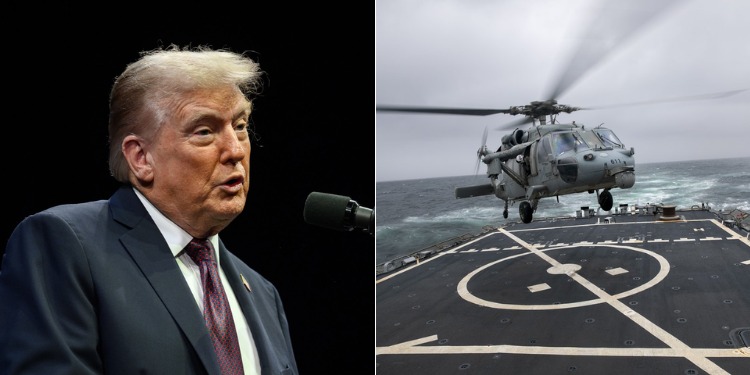
Speaking at the White House on Thursday, February 12, while taking questions after announcing the formal reversal of the Obama-era 2009 “endangerment finding,” Trump signaled rising pressure on Tehran as nuclear negotiations continue amid growing regional tensions.
He tied the military build-up directly to diplomatic negotiations, warning Iran that rejecting a deal could lead to serious consequences.
“We have to make a deal, otherwise it’s going to be very traumatic. Very traumatic. I don’t want that to happen, but we have to make a deal. They should have made a deal the first time, and they got midnight hammer instead. And this will be very traumatic for Iran if they don’t make a deal. Look, if they don’t make a deal, then it’ll be a different story,” Trump said.
Trump links military pressure to nuclear talks
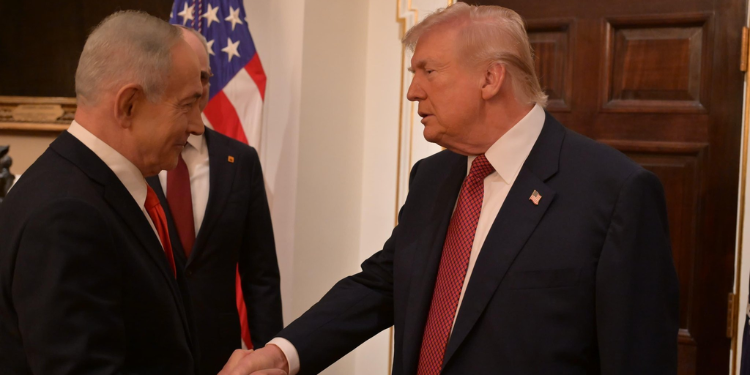
The Head of State further referenced his Wednesday White House meeting with Israeli Prime Minister Benjamin Netanyahu.
Also Read: Ukraine Downs 112 of 129 Russian Drones in Overnight Assault
He described the nearly three-hour talks as productive but centred heavily on Iran’s nuclear program, regional security and possible consequences if negotiations collapse.
“But we had a very good meeting yesterday with Bibi (Benjamin) Netanyahu, and he understands, but it’s ultimately up to me. If the deal isn’t a very fair deal and a very good deal with Iran, then it’s going to be, I think, a very difficult time for them.”
On if there a timeline for an Iran deal, Trump maintaned that “guess over the next month”, adding that “it should happen very quickly.”
His remarks come amid reports that U.S. defense officials have confirmed preparations for the possible deployment of the USS George H.W. Bush to the Middle East.
According to U.S. officials cited in a February 11 report by The Wall Street Journal, the Pentagon has ordered the aircraft carrier to prepare for deployment.
While no final deployment order has been issued, officials said the carrier could accelerate its departure and reach the region within two weeks if required.
If dispatched, the USS George H.W. Bush would join the USS Abraham Lincoln, which is already operating within the U.S. Central Command (CENTCOM) area of responsibility in the Arabian Sea.
The Nimitz-class carrier carries more than 65 aircraft, including F-15E Strike Eagles, and is supported by guided-missile destroyers such as the USS Frank E. Petersen Jr., USS Spruance and USS Michael Murphy.
Also Read: Another Iranian Strike? US Readies Second Aircraft Carrier as Trump Signals Possible Action
The Abraham Lincoln Carrier Strike Group recently sailed through the Arabian Sea accompanied by supply ships and U.S. Coast Guard cutters, with Carrier Air Wing 9 conducting aerial operations overhead.
U.S. officials say the potential second-carrier deployment is designed to boost deterrence, increase readiness and provide Washington with broader military options amid escalating tensions with Iran and ongoing nuclear negotiations.
The move also coincides with unrest inside Iran and heightened regional volatility, adding to pressure on Tehran as talks with Washington continue.
Talks with Netanyahu
Trump’s comments followed a nearly three-hour White House meeting with Israeli Prime Minister Benjamin Netanyahu focused heavily on Iran, regional security and the status of nuclear negotiations.
Trump described the talks as productive but said no final agreements were reached beyond a shared emphasis on continuing negotiations with Tehran.
“There was nothing definitive reached other than I insisted that negotiations with Iran continue to see whether or not a deal can be consummated,” Trump said after the meeting. “If it cannot, we will just have to see what the outcome will be.”
Netanyahu reiterated Israel’s security concerns during the talks, particularly regarding Iran’s ballistic missile program, nuclear ambitions and support for regional proxy groups.
According to a statement from the Israeli Prime Minister’s Office, both leaders discussed possible scenarios if negotiations collapse and agreed to maintain close coordination.
Follow our WhatsApp Channel and X Account for real-time news updates.