The Ministry of Education has issued a clarification regarding senior school learners participating in co-curricular activities, including the Kenya National Drama and Film Festival (KNDDF) and school games.
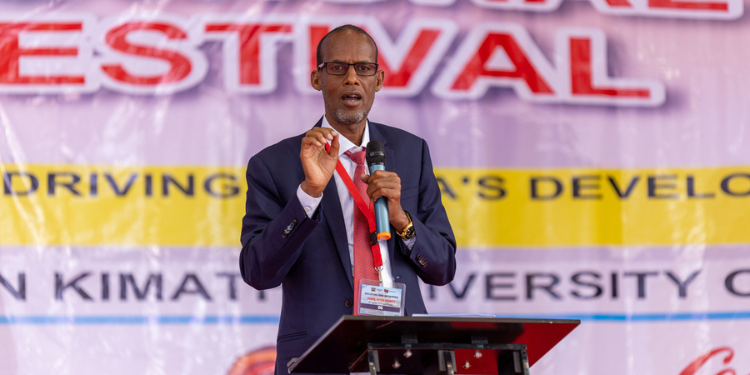
Speaking at Kagumo Teachers Training College in Nyeri during the opening of the 64th Kenya National Drama and Film Festival, Education Director General Dr. Elyas Abdi Jillaow stated that all students, regardless of their academic pathway—including STEM—are entitled to take part in co-curricular activities such as drama and film.
He cautioned schools against barring senior school learners from participating in the festival.
MoE Says All Senior Schools Learners Should Participate in Curriculum Irrespective of Pathway
According to Jillaow, through the lens of Competency-Based Education (CBE), the drama and film festival helps cultivate essential 21st-century skills, including critical thinking, communication, collaboration, creativity, and problem-solving—skills that are indispensable to all learners.
“In CBE, if somebody is doing STEM, that does not mean we have banned the student from playing football or volleyball, or from coming and performing on a stage. All students, whatever the pathway, are supposed to take part in co-curricular activities,” Dr. Elyas Abdi Jillaow said.
Also Read: Approved Career Pathways for Grade 10 Learners in language and literature Track
On his part, the Kenya Institute of Curriculum Development (KICD) CEO, Prof. Charles Ong’ondo, had earlier made a clarion call, stating that senior school Competency-Based Education (CBE) learners are allowed to participate in co-curricular activities, regardless of their pathways.
“Do not tell learners who are doing STEM that they are not eligible to participate in the Kenya National Drama and Film Festival or even the Music Festival. Drama and film remain co-curricular activities. Please let all our learners participate regardless of their pathways,” he said.
He added that Grade 10 learners are participating in the festival for the first time, with their work contributing directly to assessment and learner portfolios under Competency-Based Education (CBE).
Ong’ondo noted that this year’s students will serve as the benchmark for future cohorts.
According to Ong’ondo, Grade 10 learners are now specializing in various pathways, with some participating in theatre and film not just as a co-curricular activity but as a learning area in which they are assessed and whose work forms part of their portfolio.
“This is the first year we have Grade 10 learners participating in this festival. We are very happy that they are now part of this stage, and some of them are doing well, either in solos or in group items,” he said.
Grade 10 learners are specializing in various pathways. Some are participating in theatre and film not just as a co-curricular activity, but as a learning area in which they will be assessed, and in which what they do here will form part of their portfolio.”
Also Read: School Principals Countrywide Directed to Submit Grade 10 Learner Data
School Drama Themes
While responding to the themes, KNDFF Chairperson Professor Christopher Joseph Odhiambo said they serve as a guiding framework, allowing schools to interpret them creatively. Odhiambo thus cautioned scriptwriters against misinterpreting the themes to serve selfish agendas.
“This theme is quite broad, and each of our schools is allowed to ‘cut a slice’ of it and treat it in their own way. The National Drama Festival, the Ministry of Education, and the government do not decide the topic for any school. We give schools and their teachers the privilege to choose the slice they can handle. Our job is not to prescribe; our job is to describe.”
He added that they are interested in a work of art that raises awareness of the social, economic, and development issues facing this country.
“Ours is edutainment: we privilege education and entertainment to deliver the curriculum and the national values of this country. Our mandate is to help the Kenyan child develop talents and skills, so they have something to live on,” he said.
Equity Bank’s Head of Education, Peter Ndoro, added that technology is transforming access to financial services, how institutions operate, and shaping how young people build their future.
“We believe that technology is a powerful equalizer. Banking is no longer confined to a physical branch. It is available anytime, anywhere through a mobile phone or digital platform,” he noted.