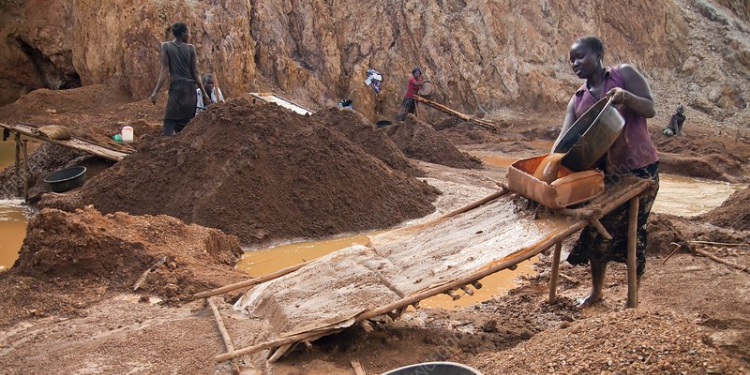

Rescue efforts are still ongoing in West Pokot County following a rockfall that hit an informal gold mining site at Rumos Hills, leaving at least 11 people injured and raising fears that more could still be trapped underground.
The incident occurred on May 7 while community members were engaged in small-scale gold mining, a common but risky activity in the area, where many residents depend on mineral extraction for their livelihoods.
According to the Kenya Red Cross, first responders were quickly deployed to the scene and were working alongside local authorities and residents to search for survivors.
West Pokot Gold Mine Collapse
Early reports indicated that 11 casualties had been recorded, including three people who sustained critical injuries and were rushed to Kapenguria Referral Hospital for specialized treatment.
The condition of the other victims was not immediately clear.
Also Read: Kenya Met Issues Flood and Heavy Rainfall Alert in Parts of the Country
Rescuers at the collapsed site reported hearing sounds from beneath the debris, raising hopes that some miners could still be alive.
The situation has intensified the urgency of the operation, with teams racing to reach those feared trapped while trying to avoid triggering further collapses in the unstable terrain.
The West Pokot mining site, described as informal, lacked the structural reinforcements and safety measures typically found in regulated operations.
Such conditions often expose workers to frequent dangers including landslides, tunnel collapses and suffocation.
Local residents joined the rescue efforts, digging through the rubble using basic tools as emergency teams coordinated a more organised response.
Red Cross said an unknown number of miners were inside the shaft at the time of the rockfall, with officials yet to establish how many remain unaccounted for.
Increasing Casualties in Artisanal Mining
At least 60 deaths were recorded in artisanal mining accidents in Kenya between 2016 and 2022, according to an Auditor-General’s report, with fatalities concentrated in counties such as Kakamega, Migori, Kisumu and Taita Taveta.
Also Read: Germany Announces Fully Funded Scholarship for Kenyans with Ksh106K Monthly Allowance; How to Apply
The same report warns that the true scale is likely higher, as some incidents go unreported due to fears that authorities may shut down sites or disrupt income streams.
Estimates show about 140,000 people are directly engaged in artisanal and small-scale mining, while roughly 800,000 rely on the sector indirectly for livelihoods, including transport, trading and processing activities.
This workforce operates largely outside formal regulation, often without engineered shafts, safety gear or supervision.
The combination of high participation, weak oversight and hazardous extraction methods creates a sustained pattern of accidents rather than isolated events.
Data from audits and field studies shows repeated incidents involving tunnel collapses, rockfalls and suffocation, frequently linked to unstable shafts and unsafe excavation practices.
The concentration of deaths over multiple years and across several counties indicates a systemic safety failure within the sector.
The scale of participation means that each collapse carries a high risk of multiple casualties, reinforcing artisanal mining as one of the most consistently dangerous informal economic activities in the country.
History of Ignored Warnings
Authorities have repeatedly warned miners to stay away from unsafe gold mining sites, particularly in West Pokot, Migori, Siaya and Kakamega, citing the risk of collapses in unregulated shafts.
Following previous incidents, local administrators and police have cautioned that many tunnels are structurally weak due to unplanned excavation and lack of reinforcement.
In several cases, officials noted that miners continued to access pits at night or after being ordered to vacate, exposing themselves to danger.
Enforcement agencies have linked repeated fatalities to miners ignoring closure directives and operating in high-risk areas, including sites previously flagged as unstable.
However, implementation remains uneven, with many miners returning to the same locations despite warnings, driven by economic pressure and limited alternative livelihoods.