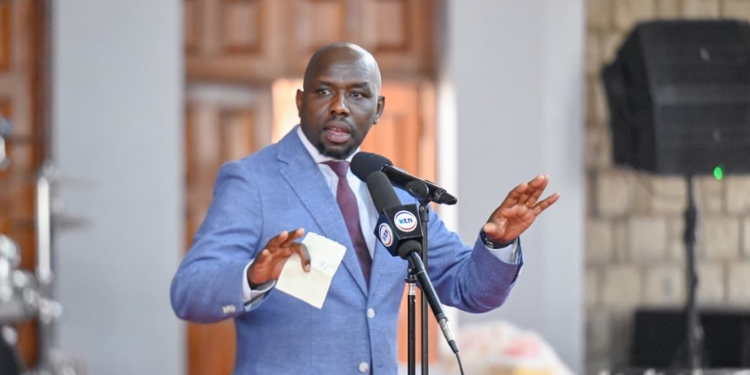
Health Cabinet Secretary Aden Duale has explained why a 2 per cent Digital Health System fee is charged under the Social Health Authority (SHA), insisting that the money is paid to the state-owned Digital Health Agency to support the country’s digital health infrastructure and not to a private company, as has been claimed.
In a statement issued on August 4, Duale said claims suggesting that public money collected through the Digital Health System is being channeled to a private company were false.
“The impression that public money is being paid to a private company outside the law is wrong, and I reject it,” Duale said.
Duale Rejects Claims 2% Digital Health Fee Is Paid to a Private Company
The CS explained that digitization is central to the government’s Universal Health Coverage (UHC) programme, enabling the registration of members, verification of healthcare services, processing of claims and settlement of payments through a secure digital platform.
He cited Section 47 of the Social Health Insurance Act, 2023, which requires member identification, pre-authorization, claims management and settlement to be conducted through a secure, interoperable and verifiable digital information system.
According to Duale, the Digital Health (Data Exchange Component) Regulations, 2025 provide the legal basis for the 2 per cent Health Information Management Service (HIMS) fee.
Also Read: Duale Breaks Silence on Ebola-Exposed Americans Being Quarantined in Kenya
He said Regulation 11(2) requires users of the shared digital health system to pay a service fee prescribed under the Third Schedule, with the HIMS fee set at 2 per cent of the value of services processed through the system, capped at KSh5,000.
“It is therefore a capped fee for the use of a system. It is not an open-ended share of any hospital’s earnings,” he said.
Health CS Says Fee Goes to State Agency, Not Private Firm
Duale clarified that the fee is paid to the Digital Health Agency, a state corporation established under the Digital Health Act, 2023, to operate and maintain the country’s Comprehensive Integrated Health Information System.
He said the agency is legally mandated to collect levy fees for services it provides, adding that the charge is a statutory fee for using a government-owned digital platform rather than a payment to a private entity.
The CS also maintained that no private company receives, controls or disburses money meant for healthcare providers.
He said only the Social Health Authority (SHA) has the legal mandate to review, process and pay claims to contracted healthcare providers, and that responsibility has not been delegated to any private firm.
According to Duale, all revenue collected by the Digital Health Agency is public money and is subject to oversight under the Public Finance Management Act and the Public Audit Act.
He said the agency’s financial statements are audited by the Auditor-General before being submitted to Parliament, adding, “There is no parallel account and no hidden ledger.”
Duale also defended the government’s contract with the Safaricom Consortium, saying the digital health system was procured in accordance with the Public Procurement and Asset Disposal Act, which allows the use of subcontractors.
Also Read: SHA Explains When Children Above 18 Still Qualify as Dependants
He stressed that subcontracting is a lawful commercial arrangement and does not entitle private firms to receive or manage public healthcare funds.
The CS further noted that the Digital Health Regulations underwent a regulatory impact assessment, public participation, stakeholder consultations and approval by both Houses of Parliament before being gazetted on April 11, 2025.
How the KSh1.2 Billion Digital Health Fee Controversy Began
Duale’s clarification follows a controversy over the 2 per cent Health Information Management Service (HIMS) fee deducted from payments made to healthcare providers under the Social Health Authority (SHA).
The issue gained national attention after hospitals questioned the legal basis for the deduction, saying they had not been informed of the charge when signing up to the SHA system and demanding clarity on who receives the money.
The controversy intensified after reports alleged that more than KSh1.2 billion collected through the 2 per cent fee had been paid to a private technology firm involved in the Digital Health System.
The reports claimed the deductions were being made from approved SHA claims before hospitals received payment, raising concerns over whether public healthcare funds were being channelled to a private company.
According to the reports, healthcare providers questioned the legal authority for the deductions, saying they had never been shown the contractual clause or statutory provision authorising the charge.
Some hospital administrators also claimed they were referred to private technology firms when seeking explanations for the deductions instead of receiving answers directly from SHA, fuelling concerns about transparency and accountability in the management of the digital health platform.
The reports further cited concerns raised by the Auditor-General regarding aspects of the Digital Health System procurement and governance arrangements.
Follow our WhatsApp Channel and X Account for real-time news updates.