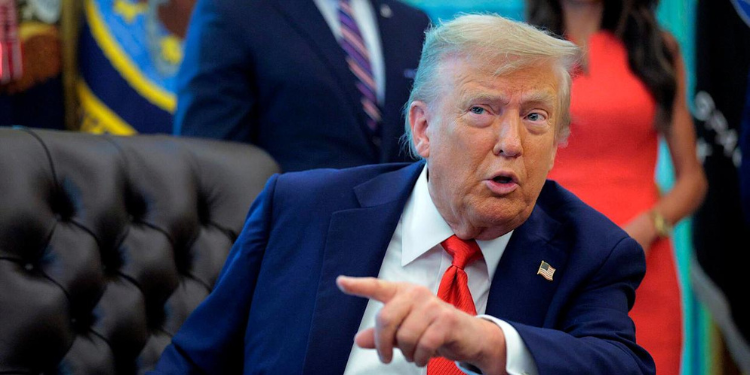
United States President Donald Trump has intensified his push for nationwide voter identification requirements.
Trump, in a series of posts on Friday, February 9, evening, declared that Voter ID will be implemented for the upcoming midterm elections regardless of Congressional approval.
This comes amid ongoing debate over the Republican-backed SAVE America Act passed by the House of Representatives earlier this week. The bill seeks to introduce stricter voter registration verification and nationwide photo ID requirements.
President Trump reaffirmed his commitment to voter identification as a central measure of election integrity.
“There will be Voter I.D. for the Midterm Elections, whether approved by Congress or not! Also, the People of our Country are insisting on Citizenship, and No Mail-In Ballots, with exceptions for Military, Disability, Illness, or Travel.”
While maintaining that he is developing “an irrefutable” legal argument to support the enforcement of the measure, Trump also cited broad public support for voter ID laws.
He signaled that, should Congress fail to pass the legislation, he may pursue an executive order to enforce the requirements, citing “legal reasons why this SCAM is not permitted” that he plans to outline shortly.
“Even Democrat Voters agree, 85%, that there should be Voter I.D. It’s only the Political ‘Leaders,’ Crooked Losers like Schumer and Jeffries, that have no shame, and explain why it’s ‘racist,’ and every other thing that they can think of,” Trump wrote.
House approval of SAVE America Act
The Trump-backed SAVE America Act passed the House of Representatives on February 11 in a narrowly divided vote of 218–213.
The legislation would expand the previous SAVE Act of 2024 by requiring U.S. citizens to show proof of citizenship during voter registration and imposing a nationwide photo identification requirement for in-person voting.
Mail-in ballots would be permitted only under strict conditions, including for military personnel, the disabled, those who are ill, or for individuals traveling during election periods.
Rep. Chip Roy (R-TX), a co-sponsor of the bill, called the legislation a “critical step toward restoring election integrity by ensuring only U.S. citizens are voting in federal elections and are showing ID.”
Roy emphasized that voter ID enjoys broad public support and urged the Senate to act quickly to bring the legislation to a vote.
Despite clearing the House, the bill faces significant obstacles in the Senate. Democrats have pledged to block or stall the measure, citing concerns that the legislation could disproportionately affect young voters, low-income citizens, and communities with limited access to documentation.
Senate Minority Leader Chuck Schumer (D-NY) called the bill “Jim Crow type laws to the entire country” and declared it “dead on arrival.”
On his part, Republican and Senate Majority Leader John Thune (R-SD) has expressed support for the bill but acknowledged that it is unclear how and when it could come to a vote.
Also Read: Trump-Backed Bill Requiring Citizenship Proof and Photo ID During Voting Approved
The legislation requires 60 votes to overcome a filibuster, and Republicans hold 53 seats, leaving passage contingent on substantial Democratic support.
Key GOP senators, including Lisa Murkowski (R-AK) and Susan Collins (R-ME), have raised concerns over aspects of the bill.
Trump links voter ID push to broader political strategy
President Trump framed the voter ID debate within a broader narrative about national security, election integrity, and the judiciary.
In his post, he also referenced potential threats posed by Democrats’ legislative agenda, including court expansion and changes to the filibuster.
“Our Country will never be the same if they allow these demented and evil people to knowingly, and happily, destroy it,” Trump wrote, emphasizing the stakes he sees in upcoming elections and legal battles.
Also Read: Trump Revokes Obama-era Climate Finding in ‘Largest Deregulation in History’
The President further drew connections between voter ID and his administration’s broader policy priorities, including trade and tariffs.
He noted that the Supreme Court is currently reviewing the “very simple topic of Country Saving Tariffs” and urged the judiciary to consider these issues alongside election measures, highlighting his view that legal interventions can complement legislative efforts.
Critics, however, warn that rushing to implement new requirements via executive action could provoke legal challenges and heighten tensions around voting access.
Analysts note that the debate over voter ID has been a recurring theme in American politics, with Republican leaders consistently advocating for stricter verification as a safeguard against voter fraud, while Democratic leaders caution that such measures can disenfranchise certain voter groups.
Follow our WhatsApp Channel and X Account for real-time news updates.