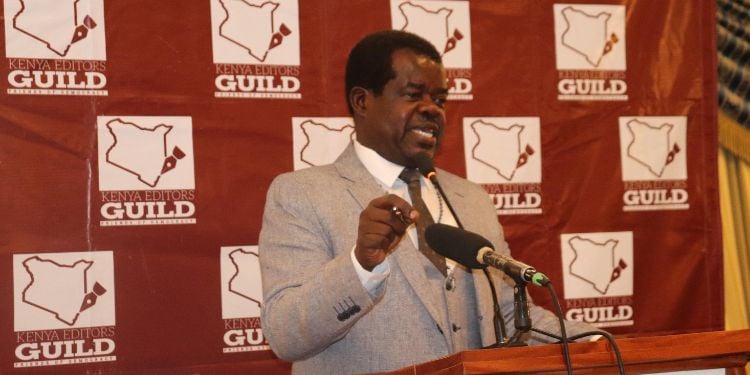
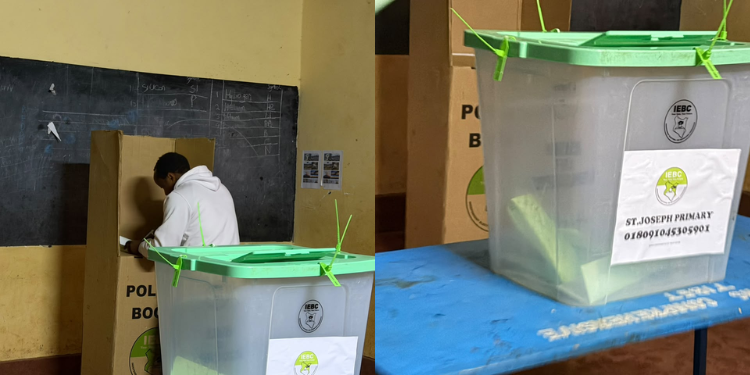
Okiya Omtatah Okoiti, leader of the National Reconstruction Alliance (NRA), filed a petition in the Nairobi High Court seeking to compel the Independent Electoral and Boundaries Commission (IEBC) to retain its original ballot paper security specifications ahead of the 2027 General Election.
In a press statement, Omtatah challenged changes the electoral commission introduced to the technical requirements for ballot papers and other election materials, arguing that the revised specifications could weaken safeguards unless their effectiveness was independently established.
“The National Reconstruction Alliance (NRA) Party has challenged the Independent Electoral and Boundaries Commission’s (IEBC) decision to relax several previously mandatory security specifications for ballot papers intended for Kenya’s electoral process, including the 2027 General Election,” the statement read in part.
IEBC had advertised Tender No. IEBC/OIT/02/2026–2027 on August 11, 2026, for the supply of ballot papers and other electoral materials.
The dispute centred on Addendum No. 3, which outlined technical relaxations intended to optimise costs and timelines.
Omtatah Questioned Revised Ballot Paper Security Features
Under the revised specifications, serial numbers were to use a single black colour instead of multi-coloured serialisation.
The commission also introduced static, rather than variable, guilloche patterns and micro-text, along with blind embossing without metallic foil stamping.
However, the revised requirements still required watermarks, ultraviolet security elements, and anti-duplication QR codes.
Omtatah argued that the IEBC had not shown that the changes provided security protection equivalent to or better than that offered by the original specifications.
“Other security features, including watermarks, ultraviolet elements and anti-duplication QR codes, remain mandatory.”
He maintained that the IEBC should have supported adjustments to ballot paper safeguards with evidence that electoral integrity would remain protected.
The petition did not allege that the commission intended to facilitate electoral malpractice or that ballot papers had already been compromised.
Instead, it questioned whether the commission adequately assessed the cumulative effect of the technical changes before adopting them.
Also Read: Who Will Check IEBC’s Presidential Result in 2027?
Omtatah asked the court to examine whether the revised requirements complied with constitutional standards governing elections and public procurement.
Petition Sought Restoration of Original Specifications
The case cited Articles 38, 81 and 86 of the Constitution, which address political rights and the requirements for free, fair, secure, accurate, transparent and verifiable elections.
It also invoked Article 227, which requires public procurement to be fair, equitable, transparent, competitive and cost-effective.
Omtatah asked the High Court to review and quash the technical relaxations to the extent that they were found unlawful.
He also sought orders requiring the IEBC to preserve the original ballot paper security specifications and obtain an independent technical assessment before implementing changes that had not been shown to provide equivalent or superior protection.
The petition placed the commission’s decision under judicial scrutiny as preparations for the 2027 polls continued.
Also Read: Who Will Be in Charge When an IEBC System Fails in 2027?
“Our concern is not that these changes automatically make ballot papers insecure, but that their cumulative effect has not been demonstrated to preserve equivalent or superior protection.”
This matter was registered as Petition No. E670 of 2026 and placed before Justice David Mburu at the Nairobi High Court. According to Omtatah’s statement, the court certified the petition as urgent, and the respondents were served with the court papers.
The court gave the respondents seven days to file their responses, with the deadline set for October 13, 2026. Omtatah stated that he had not received a response by the time he issued the statement.
In addition, the matter was scheduled for October 14, 2026, for directions, including consideration of conservatory orders.
Further proceedings were expected to determine the next steps in the challenge to the revised ballot paper security specifications.
Follow our WhatsApp Channel and X Account for real-time news updates.