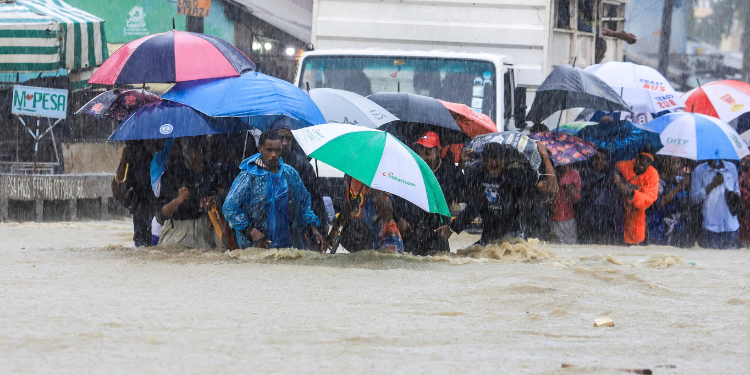
According to Kenya Met, near‑average to above‑average rainfall is likely in a few areas of Northeastern Kenya.
The Highlands East and West of the Rift Valley, the Lake Victoria Basin, the Rift Valley, the Coast, and Northwestern Kenya are expected to receive near‑average rainfall.
Meanwhile, the Southeastern Lowlands and much of Northeastern Kenya are forecast to experience near‑average to below‑average rainfall during the month.
Rainfall is expected to increase during the first week of May, when the Madden–Julian Oscillation (MJO) is forecast to be in a favorable phase.
Enhanced rainfall may extend into the second week of May in a few areas, before depressed rainfall conditions set in during the second half of the month.
Kenya Met states that the Embu Meteorological Station received the most rain in April, totaling 448.9 mm. Marsabit Meteorological Station recorded the heaviest rainfall in one day, with 232.4 mm falling within 24 hours on 25 April 2026.
Also Read: Weatherman Lists Regions Expected to Receive Heavy Rainfall
Kenya Met Regional Breakdown of Expected May Rainfall
According to Kenya Met, rainfall is expected to the near average in the Highlands West of the Rift Valley, the Lake Victoria Basin, and the Rift Valley, with heavy rainfall events likely during the first half of the month.
Similar near‑average conditions are forecast for Northwestern Kenya, including Turkana and Samburu counties, with isolated heavy rainfall events early in May.
For the Highlands East of the Rift Valley, near‑average rainfall is expected in Laikipia, Nyeri, Nyandarua, Murang’a, Kirinyaga, Kiambu, Nairobi, and the western parts of Meru.
Eastern Meru, Tharaka-Nithi, and Embu counties are likely to receive near-average to below-average rainfall, though heavy rainfall events may still occur during the first half of the month.
The department says Northeastern Kenya, including Mandera and the northern parts of Wajir and Marsabit counties, is expected to receive near‑average to above‑average rainfall.
Other areas in the region are likely to experience near‑average to below‑average rainfall, with isolated heavy rainfall events possible early in the month.
Meanwhile, the Southeastern Lowlands covering Machakos, Kitui, Makueni, Kajiado, Taita-Taveta, and the inland parts of Tana River County are forecast to receive near-average to below-average rainfall.
However, the western parts of Kajiado County may record near‑average rainfall during the month.
Along the Coast, covering Mombasa, Kilifi, Lamu, Kwale, and the Tana Delta, rainfall is expected to be near average, with isolated heavy rainfall events during the first half of May.
Also Read: Weatherman Lists Nairobi Estates Expected to Experience Heavy Rainfall This Week
Impacts and Seasonal Outlook for the Coming Months
Kenya Met warns that continued heavy rainfall in some regions may lead to waterlogging, flooding of croplands, disruption of transport and other infrastructure, and increased public health risks.
In contrast, areas expected to receive lower rainfall may experience only limited improvement in water availability.
Looking ahead, May marks the cessation of the long rains season in most parts of the country.
However, rainfall is expected to continue into June over the Highlands West of the Rift Valley, the Lake Victoria Basin, the Coast, parts of the Rift Valley, and Northwestern Kenya.
Additionally, Kenya Met says June will mark the start of the cold and dry season, which is expected to extend into July and August.
Despite the cooler conditions, mean temperatures are likely to remain above average across most of the country.