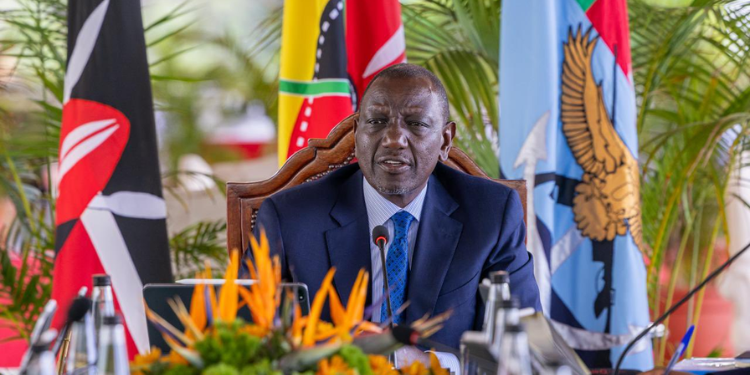
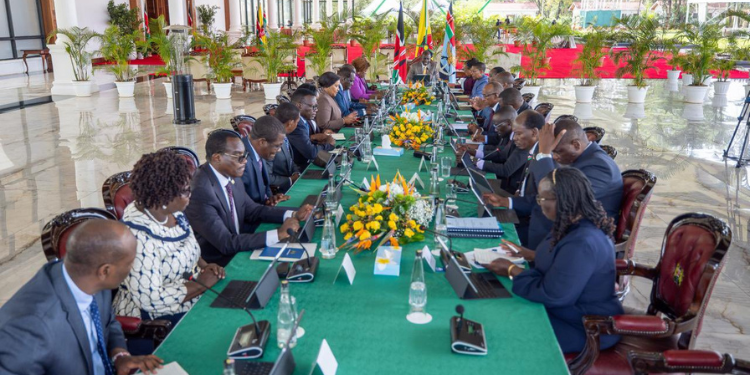
The Cabinet has approved a series of far-reaching payroll reforms to tackle long-standing integrity issues within the Public Sector payroll following a meeting chaired by President William Ruto.
In a dispatch on Tuesday, February 10, the Cabinet said that the decision follows a special audit covering the 2024–2025 financial year.
The audit uncovered widespread anomalies in the Government Human Resource Information System–Kenya (HRIS-K), including failures in governance, cybersecurity, and statutory deductions.
It found that 720 system editors altered more than 4.7 million payroll records without audit trails, including instances where staff edited their own records, raising serious governance concerns.
Audit reveals payroll irregularities
Also, the review noted that about 300 State Corporations have yet to migrate to HRIS-K, contributing to gaps in payroll oversight and statutory compliance.
“The Cabinet has approved far-reaching payroll reforms to address long-standing payroll integrity issues left unresolved by successive administrations, and to ensure statutory deductions are uniformly applied at source,” the dispatch notes.
Other issues highlighted include identity record discrepancies, weak tax compliance, unauthorised payments, excessive salary arrears, expired ICT licences, and inadequate disaster-recovery arrangements, all of which put public funds at risk.
Also Read: Win for Kenyans as CBK Lowers Lending Rates by 25 Basis Points
The Cabinet confirmed that immediate stabilisation measures have already been implemented and sanctioned a comprehensive reform roadmap.
“This includes mandatory security certification by 11 March, 2026, deployment of forensic analytics to guide disciplinary and legal action, a governance reset of HRIS-K, and full integration of a statutory deductions platform.”
This comes months after the National Treasury Cabinet Secretary John Mbadi back in June 2025, while presenting the 2025/2026 budget estimates in Parliament, said the unified HR management system would be rolled out across all public sector entities by July 2025.
CS Mbadi at the time noted that the initiative aimed to boost efficiency, tighten wage bill oversight, and improve the overall use of public funds.
“The government will fully implement the unified human resource management system across all public sector entities by July 2025. This initiative is part of a broader effort to enhance public sector efficiency, improve management of the wage bill, and ensure effective public utilization of resources,” said Mbadi.
The CS added that the Salaries and Remuneration Commission (SRC) would also intensify its phased approach to streamline allowances in the public service.
According to him, SRC would progressively review allowances and benefits in future collective bargaining agreements, aligning them to the allowances policy guidelines for the public service.
Ksh4.7 trillion budget approved
Meanwhile, the Cabinet has approved the FY2026/27 national budget totalling Ksh4.7 trillion, projecting Ksh3.53 trillion in revenue against Ksh4.7 trillion in expenditure.
The spending plan allocates Ksh3.46 trillion for recurrent expenditure, Ksh749.5 billion for development, Ksh495.7 billion in transfers to county governments, and Ksh2 billion for the Contingency Fund.
Also Read: Sakaja’s Cabinet Addresses Relocations as Nairobi Moves to Enforce Riparian Laws
Under the Division of Revenue Bill, 2026, county governments are set to receive Ksh420 billion as equitable share, equivalent to 21.9 percent of the most recent audited revenue, alongside Ksh15.2 billion for the Equalisation Fund.
An additional Ksh75.7 billion is proposed through the County Governments Additional Allocation Bill, 2026, bringing total transfers to counties to Ksh495.7 billion.
“The macroeconomic outlook remains positive, with GDP growth projected at 5 per cent in 2025 and 5.3 per cent in 2026, supported by favourable weather, improved agricultural productivity, climate-smart investments, and continued implementation of the Bottom-Up Economic Transformation Agenda,” the dispatch adds.
Separately, the Cabinet authorised Phase III of the Kenya-China Project to equip 70 Technical and Vocational Education and Training colleges with modern training equipment, enabling full rollout of Competency-Based Education and Training.
The programme will cover eight priority technical disciplines and train 1,190 instructors, strengthening industry-relevant skills, supporting MSMEs, and advancing human capital development under Vision 2030.
Follow our WhatsApp Channel and X Account for real-time news updates.