
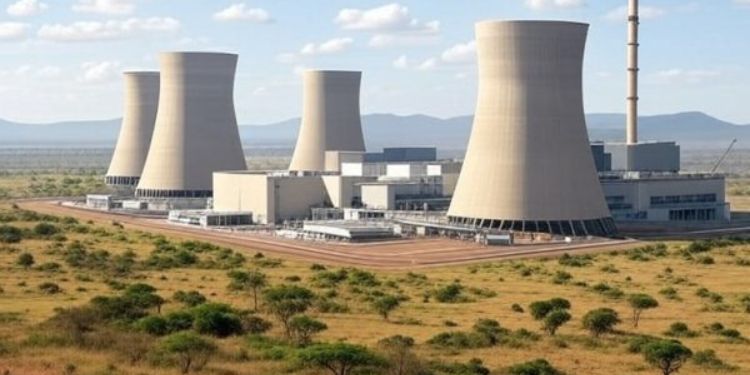
Kenya has a rare problem in the developing world: an embarrassment of energy riches. Sitting astride the Great Rift Valley, the country has access to geothermal resources that scientists estimate could yield up to 10,000 megawatts of electricity — enough to power the entire East African Community several times over. Kenya’s proximity to the equator gives it year-round solar radiation averaging over 5 kilowatt-hours per square metre per day, one of the highest in the world. Its wind resources, dramatically demonstrated by the Lake Turkana Wind Power Plant — Africa’s largest — are abundant and underexploited. And now, Kenya is pursuing nuclear.
With so many clean energy options on the table, the question Kenyans deserve an honest answer to is this: given limited capital, limited government bandwidth, and a real urgency to lower electricity costs and expand the grid, which energy path is actually best for Kenya?
The answer is not as simple as nuclear’s critics or its champions would like it to be.
What Kenya’s Grid Actually Looks Like in 2026
Before comparing technologies, you need to understand Kenya’s starting point.
As of December 2024, Kenya’s effective installed grid-connected capacity stood at approximately 3,192 megawatts. The mix is overwhelmingly clean: geothermal accounts for roughly 29%, hydro 26%, thermal 18%, wind 14%, and solar 7%. Kenya generates around 90% of its electricity from renewable or clean sources — a figure that puts it ahead of almost every major European economy.
The IEA categorises Kenya as having entered an “advanced phase” of variable renewable energy integration. In plain language: Kenya’s grid already has so much wind and solar that grid stability — managing the fluctuations when the sun is not shining and the wind is not blowing — has become a genuine technical challenge.
Electricity demand is growing at 5 to 7% annually, driven by industrial expansion, urbanisation, and the push for universal access. Peak demand currently stands at 2,316 megawatts. The National Energy Compact targets a total installed capacity of over 6,260 megawatts from renewables alone by 2030.
This context is essential for evaluating each energy technology.
Geothermal: Kenya’s Crown Jewel
Geothermal is Kenya’s most powerful energy asset and its most underutilised.
With 985 megawatts installed and an estimated potential of 10,000 megawatts, Kenya has barely scratched the surface of what the Rift Valley can deliver. Geothermal energy is baseload — it runs 24 hours a day, 7 days a week, independent of weather. It emits virtually no greenhouse gases. And Kenya is, by global standards, extraordinarily cost-effective at drilling and developing geothermal resources.
The Olkaria complex in Naivasha has been producing geothermal electricity since the 1980s and is one of the largest geothermal installations in the world. The Geothermal Development Company (GDC) has been systematically expanding capacity for over a decade, and private operators including Ormat Technologies and Sosian Energy have successfully built geothermal plants.
Also Read: Opinion | Can Kenya Finance Nuclear Without Drowning in Debt?
The case for prioritising geothermal is straightforward: Kenya has the resource, the expertise, the institutions, and the track record. Scaling geothermal from 985 megawatts to 3,000 or even 5,000 megawatts requires capital and time — but it does not require the geopolitical negotiation, the regulatory infrastructure build-up, or the technology transfer challenges that nuclear demands.
The key limitation is geography. Geothermal resources are concentrated in the Rift Valley. They cannot easily be sited in western Kenya, the coast, or the north. Expanding geothermal does not necessarily solve the electricity access problem in Siaya, Mandera, or Lamu.
Solar: Cheap, Fast, But Incomplete
Solar energy has experienced a cost revolution over the past decade that no one fully predicted. The price of utility-scale solar photovoltaic electricity has fallen by over 90% since 2010. In Kenya’s solar-rich climate, new solar projects are now among the cheapest ways to generate electricity on a per-unit basis.
For distributed, off-grid electrification — reaching the rural households that still lack power — solar is unmatched. Small solar home systems have connected millions of Kenyans to electricity at a fraction of the cost of grid extension.
But solar has a fundamental constraint that cannot be engineered away: the sun does not shine at night, and it shines less reliably during cloud cover and rainy seasons. Kenya’s grid already has enough solar and wind that managing variability has become its central operational challenge, as the IEA noted in its April 2026 assessment.
More solar generation without battery storage or complementary baseload simply creates more instability — surplus power at midday that cannot be used, shortfalls in the evening when demand peaks. At the scale Kenya is targeting (10,000 megawatts by 2030), solar alone cannot provide the stable, dispatchable baseload that industrial growth and grid reliability demand.
The honest solar argument is not “solar instead of nuclear.” It is “solar plus storage, at scale, for distribution” — while baseload capacity handles heavy industry and grid stability.
Nuclear: The Long Game
Nuclear energy occupies a unique position in this conversation: it is the only clean energy technology that delivers large-scale, weather-independent baseload power around the clock without emitting greenhouse gases.
In countries where nuclear has been built efficiently — France (70% of electricity from nuclear), South Korea (30%), Finland — it has delivered some of the cheapest electricity in the world over its operational lifetime. A nuclear plant built today and operated for 60 years will deliver electricity across six different governments, two generations of Kenyans, and at least three cycles of geopolitical turbulence.
Also Read: Will Nuclear Power Actually Lower KPLC Bills for Kenyans to Enjoy Cheaper Tokens?
The arguments against nuclear — cost, time, risk — are all real and serious, as this column explored last week. But the argument for nuclear is also serious: it is the only technology that can realistically contribute 2,000 to 3,000 megawatts of clean baseload power to Kenya’s grid by the early 2030s, complementing rather than competing with geothermal, wind, and solar.
The Honest Answer: Kenya Needs All Three
This debate is often framed as a choice: nuclear or renewables. That framing is false, and it produces bad policy.
Kenya’s energy gap — going from 3,192 megawatts today to a minimum of 10,000 megawatts — is so large that no single technology can fill it. The National Energy Compact’s own modelling calls for 1,800 megawatts of new geothermal, 2,060 megawatts of new hydro, 965 megawatts of wind, 577 megawatts of solar — and nuclear on top of that.
These are complementary, not competing. Geothermal should be expanded aggressively — it is Kenya’s fastest, most proven path to cheap baseload power and the government should be investing far more in GDC drilling. Solar should dominate off-grid rural electrification and rooftop generation. Wind should continue its expansion at Turkana and new sites. Nuclear should be pursued for the 2034 and beyond time horizon, as the cornerstone of Kenya’s industrial electricity backbone.
The question is not which technology is best. The question is whether Kenya has the institutional capacity, financial discipline, and political consistency to pursue all of them simultaneously without doing any of them poorly.
That is the hardest question of all — and the one we have not yet fully answered.
Follow our WhatsApp Channel and X Account for real-time news updates.