


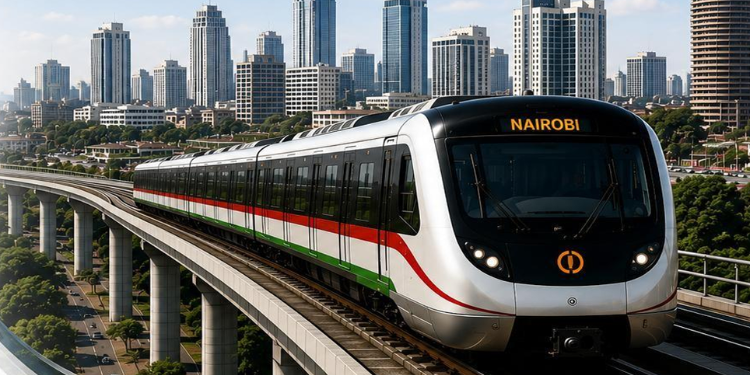
The planned Nairobi Underground Railway will feature 25 stations linking the Central Business District (CBD) to Eastlands through a network of key transport corridors.
According to the 30-kilometer Nairobi Metropolitan Mass Rapid Transit System (NMRTS) plan presented to the Nairobi City County Executive Cabinet on July 21, 2026, the system will comprise an underground CBD core and four corridors extending into Eastlands.
It aims to resolve Nairobi’s traffic gridlocks, lower transport costs, and establish an integrated network of metro rail, commuter rail, and Bus Rapid Transit (BRT).
The CBD Underground Core will have 10 stations along a 10-kilometre corridor serving as the city’s central economic distribution spine.
Stations will be located at Upper Hill, Kenyatta National Hospital (KNH), Parliament, City Hall, Kenyatta Avenue, Railways/Muthurwa, University Way, Museum Hill, Westlands, and Sarit Centre.
“The CBD Underground Core is envisioned as a ‘central economic distribution spine’ linking Upper Hill, Kenyatta National Hospital, Parliament, City Hall, Kenyatta Avenue, Railways/Muthurwa, University Way, Museum Hill, Westlands and Sarit Centre,” reads the blueprint.
Eastlands Main Trunk will feature four stations at Railways/Muthurwa, Jericho, Buruburu, and Donholm, forming the main passenger corridor into Eastlands.
The Eastlands Branch 1 corridor will include four stations serving Donholm, Umoja, Kayole, and Komarock, targeting high-density residential areas.
The Eastlands Branch 2 will also comprise four stations at Muthurwa, Eastleigh, Kariobangi, and Dandora, connecting key commercial and residential neighbourhoods.
Meanwhile, the Eastlands Branch 3 will extend through Donholm, Savannah, Fedha, and Embakasi, providing access to residential, logistics, and employment centres.
Table Shows Key Routes
Here is a summary of how the stations will be set up:
| Network Component | Route / Alignment | Length | Stations | Locations |
|---|---|---|---|---|
| CBD Underground Core | Upper Hill – KNH – Parliament – City Hall – Kenyatta Avenue – Railways/Muthurwa – University Way – Museum Hill – Westlands – Sarit Centre | 10 km | 10 | Finance, government, universities, hospitals, CBD commerce, Westlands |
| Eastlands Main Trunk | Railways/Muthurwa – Jericho – Buruburu – Donholm | 7 km | 4 | Muthurwa, Jericho, Buruburu, Donholm |
| Eastlands Branch 1 | Donholm – Umoja – Kayole – Komarock | 5 km | 4 | Umoja, Kayole, Komarock, Saika, Ruai interface |
| Eastlands Branch 2 | Muthurwa – Eastleigh – Kariobangi – Dandora | 5 km | 4 | Eastleigh, Kariobangi, Dandora |
| Eastlands Branch 3 | Donholm – Savannah – Fedha – Embakasi | 3 km | 3 | Savannah, Fedha, Embakasi |
Other Stations
According to the blueprint, several stations will serve distinct transport functions.
Kencom Central Station is planned as a major underground station within the CBD, designed to handle high passenger volumes.
Muthurwa Interchange Station will function as a multimodal hub, integrating the metro with Bus Rapid Transit (BRT), buses, taxis and non-motorized transport.
Buruburu Station is proposed as an elevated station along an arterial corridor, while Dandora Station is designed as a street-level neighbourhood station to improve accessibility.
Beyond Phase I, the long-term Vision 2063 master plan proposes expanding the network to between 80 and 120 stations across the Nairobi metropolitan area, with future corridors extending to Kiambu, Kikuyu, Lang’ata, Juja, and Jomo Kenyatta International Airport (JKIA).
Also Read: Sakaja Cabinet Approves Nairobis First Underground Railway
Core Features
The system relies on a unified, “one system” framework designed to make traveling across the metropolitan area completely seamless:
- Integrated Multi-Modal Network: The high-capacity metro serves as the central transport backbone, fully integrated with Bus Rapid Transit (BRT) routes, feeder buses, and dedicated Non-Motorized Transport (NMT) infrastructure such as walking and cycling paths.
- Unified Smart Ticketing: Commuters can use a single contactless card to pay for all modes of transit, eliminating the hassle of separate fares across different vehicles.
- High-Performance Infrastructure: By using high-speed, high-capacity electric rail, the network will deliver fast, dependable, and safe everyday service.
- Universal Design Standards: Every station incorporates lifts, escalators, tactile ground surface indicators, and step-free access so that passengers of all abilities can navigate the system easily.
- Transit-Oriented Development (TOD): Urban planning centers around stations such as affordable housing, shops, and office spaces—all within a comfortable 5-to-10-minute walk (400–800 meters).
- Real-Time Commuter Updates: Integrated digital display boards and audio systems keep passengers continuously informed with up-to-the-minute schedule and arrival updates.
Also Read: Sakaja Outlines Next Priorities in Nairobi’s City Revamp After Cabro Works in CBD and Uhuru Highway
How It Will Be Financed
Financing for the USD 7.78 billion Phase I investment of the Nairobi Metropolitan Mass Rapid Transit System (NMRTS) will be structured through a Blended Financing Model.
Here is the breakdown of how it will be financed:
Public Sector (National & County Governments): USD 3.00 billion (38.6%). Comprising direct budgetary allocations, land provision, utility support, and a dedicated Viability Gap Funding (VGF) framework.
Multilateral Development Banks (MDBs): USD 2.00 billion (25.7%). Expected to be secured through long-term concessional credit facilities from international institutions, including the World Bank Group, the African Development Bank (AfDB), and the Asian Development Bank (ADB).
Private Equity & Strategic Investors: USD 2.00 billion (25.7%). Targeting long-term equity commitments from global infrastructure funds, sovereign wealth funds, and strategic transit operators.
Pension Funds: USD 1.11 billion (14.3%). Mobilizing stable domestic capital from major local pension schemes, including the National Social Security Fund (NSSF) and the County Pension Fund (CPF).
Climate Finance & Green Funds: USD 1.00 billion (12.9%). Sourced via climate-focused mechanisms, including the Green Climate Fund (GCF), Global Environment Facility (GEF), green bonds, and carbon financing streams to underwrite low-carbon infrastructure.
Follow our WhatsApp Channel and X Account for real-time news updates.


How do you protect against corruption
Good idea , but please Please PLEASE stay with the CHINESE…..the Mzungus will tie up the project with ENDLESS discussions and plannings.