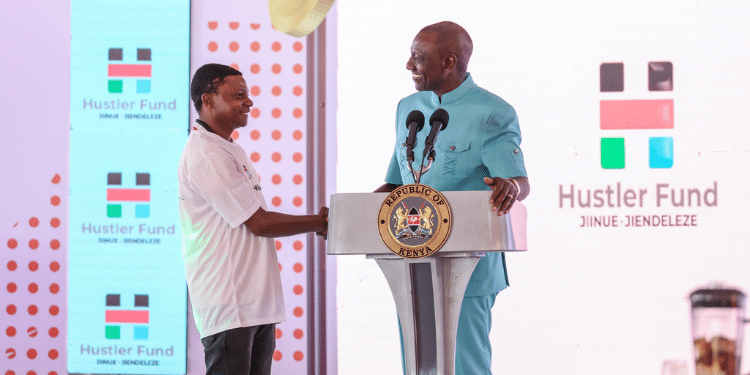
The management of Kenya’s Hustler Fund is under sharp scrutiny after the Auditor General revealed that nearly 400,000 loan defaulters were irregularly let off the hook, potentially exposing taxpayers to losses amounting to KSh377.5 million.
According to the latest report on the Financial Inclusion Fund for the financial year ending June 2025, thousands of loan accounts were closed despite having outstanding balances.
The report raises questions about accountability, transparency, and recovery procedures within one of the government’s flagship financial inclusion programs.
The audit findings indicate that 386,735 borrowers had their accounts marked as closed without explanation, even though the principal loan amounts had not been fully repaid.
Loans were issued via Safaricom SIM cards, a key channel that Hustler Fund uses to disburse microloans to Kenyans.
The report also flagged cases where the Hutler fund loans were issued to an additional 11,550 borrowers before they had repaid their initial loans.
Also Read: How Govt Plans to Splash KSh300M on Chasing Kenyans Who Have Refused to Pay Hustler Fund
Auditor Flags Irregular Account Closures
Kenya’s Auditor-General Nancy Gathungu noted that the closure of the accounts was not supported by any documented justification or approval process.
The report indicates that accounts were shut down despite clear evidence that outstanding balances remained unpaid.
“The outstanding principal on these accounts amounted to Sh377,490,360, which should have been recovered before account closure. Management did not provide any evidence to justify or support the closure of these accounts,” the Audito General stated in the report.
The audit further describes the action as irregular, raising concerns over internal controls and the mechanisms used to monitor loan repayments.
Closing loan accounts before full repayment goes against Regulation 23 of the Public Finance Management (Financial Inclusion Fund) Regulations, 2022, which states that a financial product or service advanced under these Regulations shall be repaid in full within the period determined in the agreement, and that all sums due to the Fund are recoverable as a debt owed to the Fund.
In March, the Department for Micro, Small, and Medium Enterprises (MSME) reported to the National Assembly that out of Ksh 83 billion disbursed, Ksh 71 billion had already been repaid.
The department also requested an additional KSh300 million to support recovery efforts for KSh 12.5 billion in loan defaults.
Safaricom-Based Accounts at the Center of Controversy
The affected loans were issued via Safaricom SIM cards, which serve as the primary platform for Hustler Fund transactions.
This digital-first approach was designed to make borrowing and repayment seamless, especially for low-income earners and small-scale traders.
However, the audit suggests that despite the technological safeguards, a significant number of accounts were closed without full recovery of principal amounts.
Also Read: How Kenyans Can Raise Hustler Fund Limit from Ksh 500 to Ksh 150,000
Management Silence and Pending Questions
Hustler Fund Chief Executive Officer Henry Tanui did not respond to multiple requests for comments regarding the circumstances surrounding the account closures.
Questions were first sent on March 25, 2026, followed by several reminders through phone calls and text messages to his known mobile number.
Hustler Fund was launched as a key government initiative to provide affordable credit to millions of Kenyans excluded from formal banking systems under the Bottom-Up Economic Transformation Agenda (BETA).