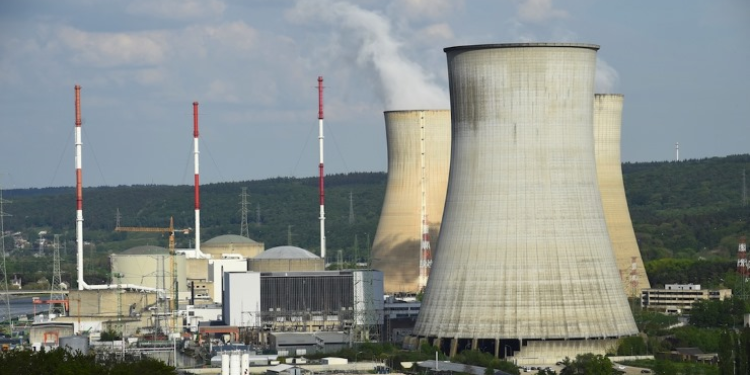
Energiewende is a very bizarre hill that even to this day proponents of a 100% choose to die. By 2023 Germany was operating more than 170 gigawatts of renewable capacity, a true marvel of engineering achievement if ever there were any. Carbon Intensity, however, was at roughly six times that of France, which with only 63 gigawatts keeps most running above 75% capacity factor year-round.
The distinction between the two is the difference between Installed Capacity which describes what a grid can produce under ideal conditions and Dispatchable power which describes what can be delivered when, say, a data centre demands it at two in the morning in winter.
This is no longer an abstraction, but a strategic variable taken very seriously by frontier AI models looking to meet the demands that come with sustained compute loads that cannot be rescheduled for when the wind picks up or the sun rises.
Old Lessons by the new teacher
Such dichotomies are not exactly unprecedented.
From its very dawn, the strategic gem of the nuclear era was not in excess of raw material but in the high-precision intermediate process. Today Kazakhstan accounts for more than a third of global uranium output, but enrichment is what is on everyone’s mind. Countries that operate reactors without domestic enrichment capability are permanently dependent on a handful of suppliers for the fuel that keeps their baseload running.
The 2022 sabotage of the Nord Stream pipelines sharpened the same point for Liquified Natural Gas (LNG).
Also Read: Kenya Energy Demand Surges as Renewables Hit 78.79% of Supply
The same architecture has been reproduced this with striking fidelity in the age of semi-conductors. Nvidia designs practically most of the processors that underpin frontier AI training. TSMC fabricates them using extreme ultraviolet lithography equipment produced exclusively by ASML.
Governance of what for who and by who?
The parallels, between the export controls The United States has deployed hoping to dampen China’s rise as a per competitor in the age of AI and the controls governing enrichment under The Nuclear Non-Proliferation Treaty (NPT) are startling. They are however still different if you know what to look out for.
Atoms for Peace and the International Atomic Energy Agency (IAEA) were negotiated long after the bombing of Hiroshima and Nagasaki. While it is true that by the time delegates were convening at Bletchley Park AI Safety Summit in November 2023 to discuss AI risks, the models under discussion had already been trained, deployed, and embedded in commercial infrastructure, there were no institutions set up that can mirroring the IAEA.
Africa’s Position
Africa is projected to account for roughly a quarter of global population by 2050, with a workforce potential that AI-driven automation in labour-intensive sectors will directly affect. Kenya’s digital economy with a reported 97.5% of internet penetration in the relevant age group, and the more than 290 digital hubs supporting annotation and reinforcement learning from human feedback gives a glimpse of what awaits. Annotation arguably occupies the same position in the AI value chain that uranium mining occupies in the nuclear fuel cycle and the energy constraint compounds this.
Also Read: From Rain-Soaked Commutes to Nuclear Power: Why Kenya’s Energy Future Can’t Wait
Though Sub-Saharan Africa’s installed generation capacity has grown, reliability across all industrial corridors remains inconsistent. Institutional frameworks capable of absorbing long development timelines of power supply projects by attracting patient capital are thin at best. Without reliable dispatchable power, advanced data infrastructure cannot be operated at commercial scale.
Without that infrastructure, the higher-value segments of the AI supply chain remain structurally inaccessible.
The Case Against Pessimism
But technology is not static. Open-source models have narrowed the capability gap between frontier proprietary systems and what runs on the commodity hardware that adds little to the baseload.
Baseload power itself is not the only path to reliable AI infrastructure though. Batch processing can be scheduled around renewable availability in ways that real-time inference cannot. A national AI strategy that routes time-sensitive workloads to reliable infrastructure while accepting intermittent supply for less critical processing may achieve more than binary dispatchability analysis implies. Export restrictions on advanced chips to China have also shown that while software diffuses fast computer hardware circulates in global supply chains at volume, leaving them vulnerable to chokepoints that though not structurally fixed as real as ever.
Sovereignty Defined
If AGI’s potential dwarf the culmination of the race to build the first bomb, it is then instructive that Africa’s AI strategy takes a long hard look at the Manhattan Project. The justification for this project was to establish an edge over everyone else. The rules and regulations that govern access to nuclear technology were shaped later by a handful of states who already had it and thus had a clear understanding of what was being negotiated.
Whether AI’s faster diffusion, software-intensive character, and commercially driven development trajectory leaves more room for late movers than the nuclear precedent is genuinely uncertain, the countries that will matter will not be those with the most abundant resources.
Sovereignty remains the same as it has always been. It is having a seat at the table where the rules are being made. Nature abhors a vacuum so if Africa doesn’t deliberately claim seats at the table, they will soon get filled by others condemning all 1.5 billion of us yet to yet another epoch of mere consumption rather than actual production.
Follow our WhatsApp Channel and X Account for real-time news updates.