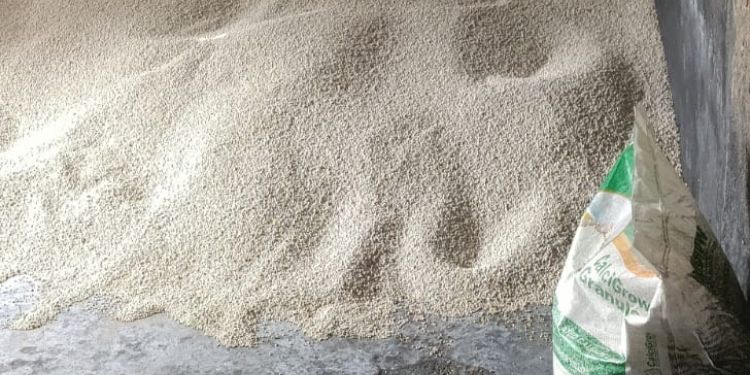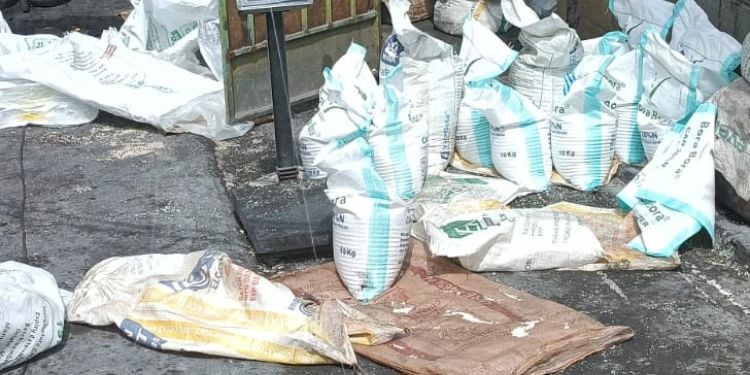
250 bags of fake fertilizer linked to agricultural criminal networks have been seized in Kakamega during a raid targeting illegal agricultural inputs in Kenya.
The operation on illegal agricultural inputs was carried out by the Anti-Counterfeit Authority (ACA), the Directorate of Criminal Investigations (DCI), the Kenya Bureau of Standards (KEBS), and the Government Chemists.
In a statement dated April 20, the Anti-Counterfeit Authority noted that, in addition to the counterfeit fertilizers, the investigators recovered various packaging materials.
A consignment of the government subsidy stock that had been marked as not for sale was also recovered, with allegations that the scheme was intended to divert and repack the state-funded resources for illegal trade.
“Beyond the bulk fertilizer, investigators recovered various packaging materials and a consignment of government subsidy stock marked “Not for Sale,” suggesting a sophisticated scheme to divert and repackage state-funded resources for illegal trade,” part of the statement read.
Effect of Fake Fertilizer on National Food Security
The seizure of counterfeit fertilizers coincides with the peak planting season amid ongoing rains across the country.
According to the Anti-Counterfeit Authority, during the peak planting season, the demand and investments by farmers in agricultural inputs are high, hence farmers are vulnerable to fake schemes and substandard inputs.
The ACA Regional Manager for Kisumu emphasized that the presence of fake and substandard fertilizers is concerning, as it directly affects crop production and national food security.
Additionally, he explained that farmers rely on the authenticity of agricultural products to achieve high production rates.
Any compromises at the early crop planting stage would subsequently affect the individual livelihood and the agricultural economy, according to the ACA Regional Manager for Kisumu.
Also Read: Agriculture and Food Authority Announces Permanent and Pensionable Jobs
Risk Associated with Fake Fertilizers
According to the Anti-Counterfeit Authority, counterfeit fertilizers not only cause immediate financial loss due to poor-quality yields but also lead to long-term soil degradation.
Further, the substandard inputs also lead to poor crop development as the inputs lack the essential nutrient balance required for healthy crop growth.
Stunted harvest from the harvest of crops grown from substandard inputs affects the overall food production capacity, according to the ACA.
Additionally, the counterfeit inputs having a presence in the supply chain undermine the government’s efforts to provide affordable, high-quality inputs through subsidy programs, and hence effectively sabotage the agricultural sector’s growth.
Also Read: Kenya Among Nations Facing Fertilizer Crisis as Hormuz Disruption Hits Supply
Action by the Anti-Counterfeit Authority
The Anti-Counterfeit Authority has established surveillance and enforcement through its multi-agency framework to curb the threat of counterfeit and substandard agricultural products.
Moreover, officials from the Anti-Counterfeit Authority have advised the farmers and the general public to be cautious and make purchases from authorized and reputable dealers.
In addition, farmers have been urged to verify the authenticity of all products and to report any suspicious packaging to the relevant authorities.
The Anti-Counterfeit Authority will remain committed to safeguarding the integrity of agricultural inputs.
Further, the ACA will ensure that farmers’ investments are protected and that the national food supply remains secure.