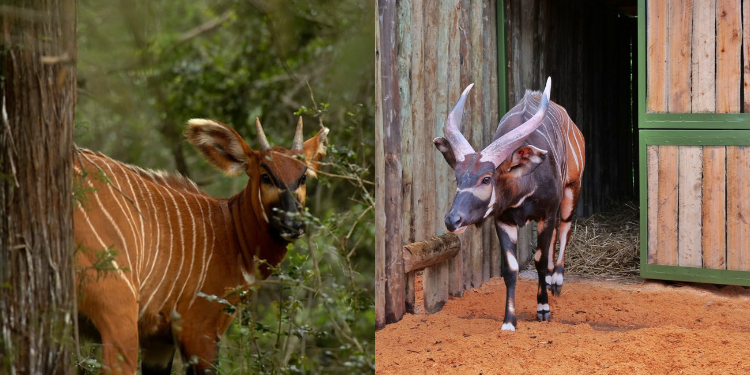
Four Mountain Bongos arrived at the Jomo Kenyatta International Airport from Europe on Tuesday night, with the Kenya Wildlife Service (KWS) leading efforts to return the endangered species to the wild.
In a statement on April 28, the KWS confirmed the arrival, saying the repatriation was undertaken as part of the National Recovery and Action Plan for the Mountain Bongo.
Mountain Bongos are a critically endangered species and are considered a rare type of antelope in the world.
“Tonight at Jomo Kenyatta International Airport (JKIA), Kenya welcomed four rare Mountain Bongos back home,” noted KWS in a statement.
KWS said the transfer followed years of scientific planning and cooperation between the Government of Kenya and international conservation partners to rebuild the species’ population.
KWS‑Led Effort Strengthens Mountain Bongo Recovery Program
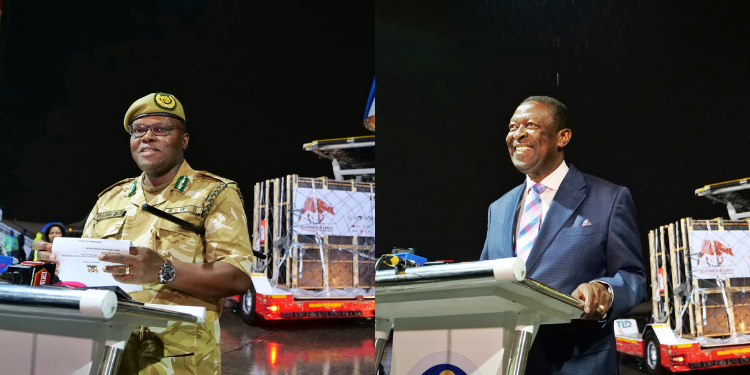
The Mountain Bongos were received at the JKIA by Prime Cabinet Secretary and Cabinet Secretary for Foreign and Diaspora Affairs, Musalia Mudavadi, and Cabinet Secretary for Tourism and Wildlife, Rebecca Miano.
Also present were Kenya Wildlife Service (KWS) Director General Prof. Erustus Kanga, Czech Republic Ambassador to Kenya H.E. Nicol Adamcova, Mount Kenya Wildlife Conservancy (MKWC) patron Humphrey Kariuki, officials from the Kenya Airports Authority (KAA), and representatives of KLM.
Also Read: KWS Issues Statement on Court Verdict in Ant Smuggling Case
According to KWS, the four males were transported to Mount Kenya Wildlife Conservancy, which serves as the main breeding and recovery site for the Mountain Bongo.
The conservancy currently hosts 102 bongos, and the service noted that the arrival of the four males will strengthen the gene pool and improve breeding resilience.
Speaking at the reception, KWS Director General Erustus Kanga said the return of the bongos gives new hope and demonstrates a renewed commitment to saving the species, adding that their survival will depend on continued conservation efforts, strong partnerships, and careful breeding management.
Humphrey Kariuki said the additional males will help support the long-term success of the breeding program at MKWC, while CS Rebecca Miano emphasized that introducing genetically diverse animals is essential to building a healthy, resilient population capable of eventual reintroduction into the wild.
On his part, Musalia Mudavadi noted that successful repatriation demonstrates what can be achieved when government policy, science, and international collaboration work together toward a shared conservation goal.
Ambassador Nicol Adamcova described the translocation as a reflection of the long-standing partnership between Kenya and the Czech Republic in wildlife conservation and the protection of endangered species.
“With their return, Kenya moves one step closer to restoring Mountain Bongos to their natural habitats where they belong,” noted KWS.
KWS Recovery Plan for Kenya’s Endangered Mountain Bongo
The Mountain Bongo is a rare forest antelope found only in Kenya’s highland forests, including Mount Kenya, the Aberdares, Eburu, and parts of the Mau Forest.
Also Read: KWS Given 21 Days to Release Information on Kenya’s Snakebite Deaths
It is listed as critically endangered, with fewer than 200 believed to remain in the wild due to habitat loss, poaching, disease, and inbreeding.
To prevent extinction, the Kenya Wildlife Service (KWS) launched the National Recovery and Action Plan for the Mountain Bongo in 2019.
The plan focuses on protecting remaining forest habitats, stopping poaching, breeding bongos in secure sanctuaries such as Mount Kenya Wildlife Conservancy, and gradually returning them to the wild.
It also involves scientific monitoring, improving genetic diversity through carefully planned transfers from conservation centers abroad, and working with nearby communities to reduce pressure on forests.
The long‑term goal is to build a healthy, self‑sustaining population of about 750 Mountain Bongos in Kenya over the next 50 years.
KWS has confirmed that on April 29, following their arrival at Jomo Kenyatta International Airport the previous night, the four Mountain Bongos were safely transported to Mount Kenya Wildlife Conservancy in the early hours of the morning, where they are now settling in under close care, a step in strengthening their population and securing their future.