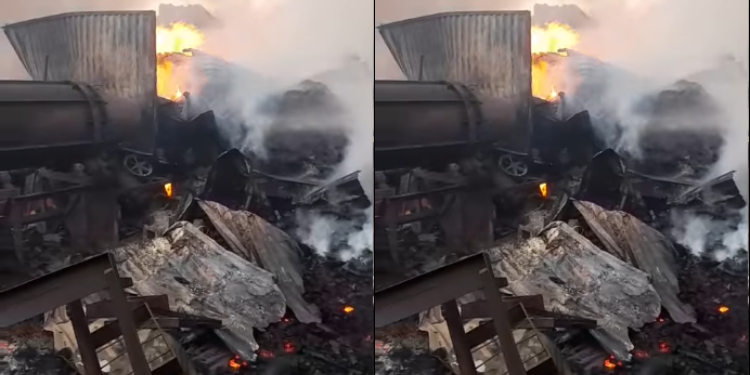

A huge fire has broken out at Kariobangi Light Industries along the busy Kwa Mbao line in Nairobi.
In a public announcement on Tuesday, May 26, the Kariobangi Social Justice Center posted an announcement on X, stating that firefighters and residents are struggling to contain the blaze.
The attached video, as seen by The Kenya Times, shows thick smoke and a spreading fire over the establishment.
Witnesses say the fire started within the densely packed structures of Kariobangi Light Industries, an area known for its mix of small-scale factories, warehouses, metal workshops, and recycling plants.
The close proximity of buildings and the presence of highly flammable materials such as plastics, chemicals, and scrap metals are believed to be fuelling the rapid spread of the flames.
Emergency teams on the ground have issued an urgent appeal for additional support to help contain the blaze, warning that resources are stretched.
“Emergency support is urgently needed on the ground. Please share widely,” the alert said, as calls for assistance spread across social media.
According to the Kariobangi Social Justice Center, preliminary findings indicate extensive property damage, although the full extent of losses has not yet been established.
Kariobangi Light Industries
Kariobangi Light Industries is one of Nairobi’s most important informal and semi-formal industrial zones, located in the city’s eastern corridor near densely populated areas such as Kariobangi North, Kariobangi South, and Kwa Mbao.
Also Read: Gachagua Fires Hezron Obaga, Appoints Senator Methu as DCP Secretary General
The area lies along Outer Ring Road and connects to key neighborhoods including Baba Dogo, Dandora, Huruma, and the Industrial Area.
It is made up of closely packed workshops, small factories, storage yards, and open workspaces, many of which are built using iron sheets and temporary materials.
The zone serves as a vital hub for small and medium enterprises, supporting thousands of workers who depend on it for daily income.
Activities in the area include metal fabrication, furniture making, textile production, plastic recycling, scrap metal processing, and automotive repairs.
These businesses play a key role in supplying affordable goods and services to many households across Nairobi.
Kariobangi Light Industries sits very close to residential settlements such as Kwa Mbao and nearby informal estates, creating both economic benefits and serious safety concerns.
While the proximity provides easy access to labor and a ready market, it also exposes residents to risks during industrial accidents.
The area faces major challenges including frequent fire outbreaks driven by flammable materials, illegal power connections and poor planning.
Congestion, narrow access roads, inadequate water supply and weak safety systems make emergency response difficult.
Also Read: Arsenal Fan Killed by Man United Supporter in Violent Football Dispute
Many businesses also operate informally, often without insurance, increasing vulnerability to heavy losses during disasters.
Emergency Response in Informal Settlements
Response to fires in Nairobi’s informal settlements typically involves a multi-agency approach, bringing together county fire services, the National Disaster Operations Center (NDOC), police, and humanitarian organizations.
These teams coordinate rescue operations, evacuations, and immediate relief, including setting up temporary shelters and distributing basic supplies to affected families.
Firefighters and emergency crews are usually the first official responders, but in many cases, local residents act as the initial line of defense, raising the alarm, attempting to control the flames using water or sand, and helping neighbors evacuate before professional help arrives.
However, response efforts in such areas face serious and persistent challenges.
The layout of informal settlements, characterized by narrow pathways, unplanned housing, and heavy congestion, often makes it difficult for fire engines and rescue teams to quickly access affected areas.
Authorities have acknowledged these gaps and continue to push for early warning systems, community training, and improved coordination to strengthen both prevention and emergency response in high-risk areas such as Kibera, Mathare, and Mukuru.