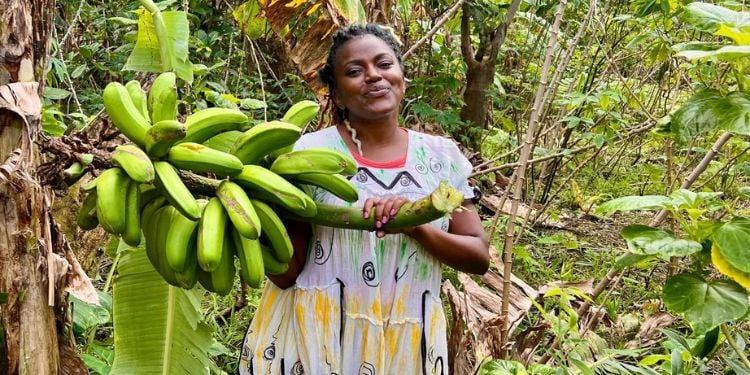
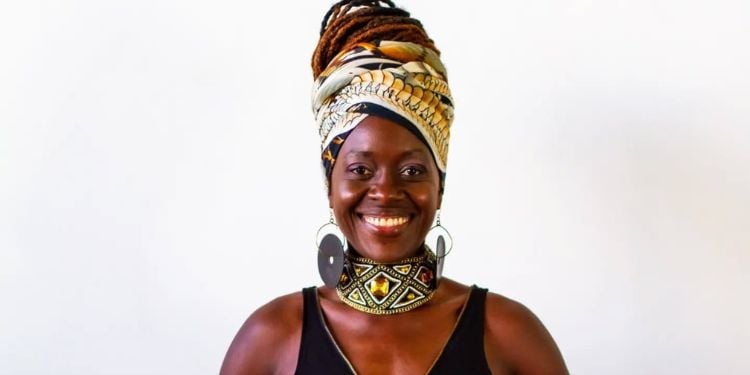
Angela Wanjiku is a Kenyan researcher who uses mapping and satellite data to study how climate and environmental changes affect large wildlife in Kenya’s Amboseli Ecosystem.
Her research tracks animals such as elephants, zebras, wildebeest, and giraffes, examining how changes in climate, land use, and vegetation influence their movement, distribution, and overall health.
Education Background
Angela Wanjiku earned her Bachelor’s degree in Geography from Egerton University in Kenya. She later pursued a Master’s degree in Geomatics at the University of Montpellier in France, completing the programme despite French being her fourth language.
She has openly shared her experience of overcoming language barriers, cultural challenges, and skepticism while studying in a non‑English‑speaking environment.
“I know you want to know how I did it and whether you can do it too: Please, I beg you, DO NOT DO IT if you are weak-hearted. Some strangers will question your decision. Most students will refuse to work with you. Some teachers will take it upon themselves to remind you that you chose a course that is taught in French,” Angela wrote in a post.
In October 2024, she began her PhD studies at AgroParisTech in Paris, France, as part of the MOSAIC European research project.
Angela’s doctoral research is hosted at the TETIS Laboratory (Territoire, Environnement, Télédétection et Information Spatiale).
Her thesis is titled “Remote Sensing and Spatial Modeling of Large Herbivore Populations and Health in Response to Environmental Changes in the Amboseli Ecosystem, Kenya.”
Also Read: Kamene Goro: CEO of NRG Radio and the Undisputed Voice Behind the Mic
Angela Wanjiku Career and Research Focus
Her research combines satellite Earth observation data, spatial analysis, and modeling tools to study how wildlife in East Africa responds to environmental change.
She uses technologies such as Sentinel‑2 satellite imagery, vegetation and water indices, and multi‑agent modeling (Ocelet) to examine how climate variability, land‑use change, and human activity affect wildlife movement and habitat use in the Amboseli ecosystem.
Her work is carried out in collaboration with local institutions and communities.
Notable Achievements
Angela has made several contributions to conservation science and open research. These include developing and publicly releasing a spatial dataset on large herbivore distribution and the environmental, climatic, and human factors affecting them in the Amboseli ecosystem.
Also Read: Profile of Kelvin Kiarie, the Engineer Who Won Continental Gold for Kenya
The dataset is available on the Zenodo open‑access platform, alongside reproducible Python and R scripts.
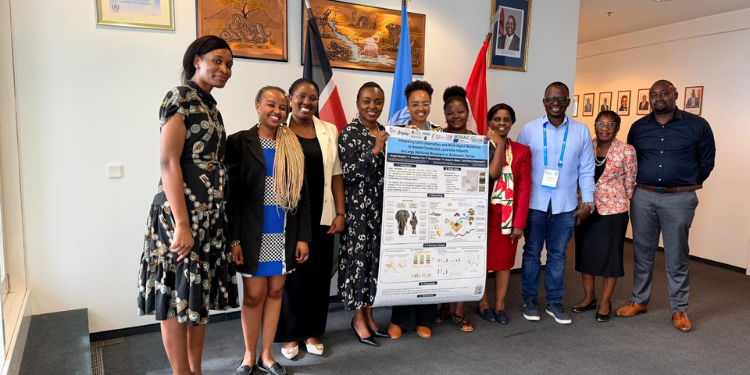
She has also presented her research at the EGU General Assembly 2026, with an abstract titled “Integrating Earth Observation and Multi‑Agent Modeling to Assess Climate and Land‑Use Impacts on Large Herbivore Movement in Amboseli, Kenya” (EGU26‑6804).
Other achievements include successfully completing postgraduate studies in a non‑English‑speaking country and sharing her academic journey to encourage African students pursuing international research careers.
She contributes to the MOSAIC international research project, supporting evidence‑based conservation planning through remote sensing and spatial modeling.
Angela’s work has been featured by the Kenya Embassy/Permanent Mission in Vienna for its use of satellite technology to monitor wildlife and climate impacts in Kenya.
She recently presented her research at the EGU General Assembly 2026 in Vienna, including a special presentation to the Embassy, where her findings highlighted animal movement patterns, resource‑scarce areas, and potential disease hotspots, which are considered valuable for conservation policy and planning.